
Table of Contents:
Our Flindt To Collins Itinerary
- Natural Resources Canada 1:50,000
- Toporama website (NRC’s digital seamless map)
- Topo Canada app for iPhone
- Wabakimi project maps
- Paddle Planner
- Ontario MNRF “Make a Topographic Map” site
- Google Earth – satellite view
The Ride There and Back – The Train From Toronto
Put-in at Flindt Landing – VIA Stop and Lodge on Heathcote Lake
Day-by-day posts – detailed maps, rapids, portage info, campsites
- Days 1 and 2 – Down The Flindt River From the CN Tracks
- Days 3 and 4 – The Flindt and Ogoki Rivers (Wabakimi Lake)
- Days 5 and 6 – The Ogoki, the Palisade, and the Grayson Rivers
- Days 7 and 8 – The Grayson River and Whitewater Lake
- The Ogoki Lodge and The Beckwith Cabins: “All Things Must Pass”
- Days 9 and 10 – McKinley Bay To Smoothrock Lake
- Days 11 to 15 – From Smoothrock Lake To Collins Via the Boiling Sand R.
———————————————–
Introduction:
Wabakimi Provincial Park in NW Ontario is an obvious choice if you want to get away from the crowds. For every hundred paddlers churning up the waters of Algonquin, Killarney, or Quetico, there are maybe one or two in Wabakimi. But for us, there is a price to pay- and that is the time needed to get there. We live in southern Ontario (London and Toronto), so Armstrong Station is a long way; if you live in Wisconsin, Minnesota or Thunder Bay, the park is almost on your doorstep!
Look at the Google map below to see where Wabakimi Provincial Park is in the bigger picture.
Our 2010 visit to Wabakimi Provincial Park gave us every reason to go back for more, and that is what we did the next year. (Check out our trip report “Discovering Wabakimi: Paddling to the Center of the Universe“ for more info.)

———————————————–
Our Flindt to Collins Itinerary:

Flindt Landing – Flindt River – Wabakimi Lake – Kenoji Lake – Palisade River – Grayson Lake – Whitewater Lake – Smoothwater Lake – Boiling Sand River – Collins
- July 23 – we left Toronto Union Station at about 10 p.m. (Note: In 2019, the schedule was changed: the train now leaves at 9:30 a.m. twice a week.
- July 24 – spent all day on the Via Canadian train and got to Flindt Landing around midnight (Since 2019, it arrives around 10 a.m.)

heading for the portage trail at dusk on the Grayson River
- Day 1 – 25 km – from Flint Landing cabin to campsite on a bay off Flet Lake
- Day 2 – 26 km – from Flet Lake to campsite on Flindt River by portage on NE end of Big Island
- Day 3 – 20 km – from lower Flindt River camp to Wabakimi Lake west end
- Day 4 – 23 km – to River Bay South shore after an encounter with a park ranger
- Day 5 – 24 km – to the start of Palisade R. after paddling up to turn-off to Slim Lake and back (9 km)
- Day 6 – 33 km – to a campsite on Grayson River before Whitewater Lake
- Day 7 – 9 km – a small island at the top of Whitewater just to the west of Porter Island
- Day 8 – 22 km – to a sand fly-infested beach on the south end of Best Island on Whitewater Lake –
- Day 9 – 22 km – halfway down Lonebreast Bay to Bussey Island campsite (one with memorial)
- Day 10 – 11 km – to the island at the north end of Smooth Rock Lake
- Day 11 – 25 km – to campsite down near the south end of the west arm of Smoothrock Lake
- Day 12 – 19 km – to Boiling Sand River campsite across from Mattice Outfitters Lodge
- Day 13 – 8 km – to Boiling Sand River after Gnome Lake
- Day 14 – 3 km – to Bath Lake just before the portage over the railway tracks
- Day 15 – 5 km to Collins and board the east-bound VIA Canadian train at 8:50 a.m. CT
Aug 09 – the Via train arrived at Toronto’s Union Station at about 10:00 a.m.
———————————————–
Maps And Related Resources:
Federal Government 1:50,000 Topographic Maps

The Federal Government 1:50000 topos provide greater detail and more context of the route to go along with the Wabakimi Project maps. You can find the topos you need at the Federal Government’s Natural Resources Canada website and print them out yourself.
Clicking here will take you to the 052 folder, where you will find the following 1:50,000 topos in either the J or the I subfolders. Each map folder contains three choices; I download the prt.tif file. Do note that a few of these maps are in black and white.
The maps below are the ones you’ll need –
- Seseganaga Lake 052 J 01
- Wilkie Lake 052 J 08
- Neverfreeze Lake 052 J 09
- Wabakimi Lake 052 I 12
- Burntrock Lake 052 I 13
- Grayson Lake 052 I 14
- Goldsborough Lake 052 I 11
- Onamakawash Lake 052 I 05
- Armstrong 052 I 06
——————-
David Crawshay’s Topo Canada App for iOS

David Crawshay’s Topo Canada iOS App for iPhone enables you to download all of the above to your iPhone. While leaving the iPhone on all day to use as your primary GPS device would eat up battery power like crazy, it is very useful to make a quick confirmation that you are indeed where you think you are! Download Crawshay’s app here.
——————-
Toporama Canada Online Map:

Toporama is NRC’s modern version of the archived topo sheets. It is essentially a seamless map of the entire country and allows you to extract from and apply all sorts of additional information and features to the map. Click here to access.

——————-
None of the above provides detailed information about rapids, portages, and campsites. For that, you will need to turn to sources like the Friends of Wabakimi.
Wabakimi Project Maps
 To get a handle on possible routes, campsites, and portages, we purchased Volume 3 of the Friends of Wabakimi (formerly Wabakimi Project) Canoe Route Maps series.
We already had Volume 1 from the previous summer’s Wabakimi trip and had found those maps quite useful. The $40 for the Wabakimi Project maps is an investment, not a splurge – but see the Paddle Planner link below for a free version!
It will get you the campsite and portage information you need; it will also help this volunteer organization to pay for the cost of flying in people who give a week or two of their time in the summer to clear and mark the portages, create the campsites, and do the mapping work that makes the route maps possible.
——————-
Paddle Planner

Click on the header above to access the site.
In the decade since this report was written, a new source of canoe route info has appeared on the internet. Its creators have collated all the available information from the sources above – and from yet other trip reports and info submitted to them by fellow trippers.
It is the same approach used by the now-defunct Jeff’s Maps and the current Unlostify maps available for some Ontario destinations. Of the data, the Paddle Planner website includes this reminder:
Wabakimi is a real wilderness area and has the challenges that wilderness brings. Portages and campsites are not as well-maintained as in other canoeing areas such as the Boundary Waters. A route may not have been traveled for years, so portages and campsites may be overgrown, hard to find, and/or may not exist anymore. All locations are approximated.
Access the site here.
Note: there is a $20. cost to access all of the useful features of the site, a minor investment that will repay itself by having mostly reliable info on what is coming up in terms of rapids, portages, and campsites. Given the nature of Wabakimi, we have found that some of the very low-level usage portages indicated no longer exist.
——————-
Ontario MNRF:

As well, the Ontario Government’s Ministry of Natural Resources and Forests has its own online map service (see here), which often provides more up-to-date and detailed maps than the Federal Government’s maps listed above. It is worth looking at them – and even printing out certain sections. If you go into Map Layers, you can access their satellite imagery, which is often better than the one in Google Earth.
——————-
Google Earth – Satellite View:
The Google Earth satellite view provides revealing views of the route, and it is worth spending a bit of time getting the satellite perspective. A web version can now be accessed within the Chrome browser.
Click here for the KML file (163 kb) of the every-ten-minutes-while-it-was-on tracks recorded by our Spot Connect during our two-week trip. Import the file into Chrome’s web-based Google Earth app as a New Project, and you should see all 730 tracks. All that is missing is the first three hours’ worth – we were still learning how to use the device!
Garmin Etrex:
Finally, we had a Garmin GPS unit (an Etrex) along for the ride as backup and occasional solution to those head-scratching “where-the-heck-are-we?” moments! We also used it to record our daily track and features like potential campsites, outposts, and rapids.
Given all the digital and paper map resources mentioned above, a smartphone would be all you need for the occasional GPS location reading.
——————-
The Spot Connect:
If you want to see the SPOT Connect waypoints of our trip, click here to download the 266k file. You can import the file into Google Chrome’s web version of Google Earth and see the GPS trail that the SPOT recorded.

iPhone and SPOT Connect
I am really glad we brought the Spot along. It provided the folks at home with real-time info on our location, and the email messaging option came in handy for sending brief “all okay” or more personalized notes back home at the end of each day (45 characters max). It does this by pairing up with your smartphone (I use my iPhone).
The Spot also provides excellent post-trip data, in particular, the amount of time we spent in certain spots along the way. It records a track every ten minutes, so if there is a one-kilometer distance between two successive tracks, you will know we were motoring. If you see progress in meters, it will mean some serious lining or portage is in progress!

Update: The Spot Connect was discontinued in 2017. While ours had served us well, we ended up getting a Garmin inReach Explorer+ in 2018 because of its two-way communication feature. You can receive emails and daily weather updates on the inReach and do all the usual tracking and emergency contact stuff. It even has a basic mapping window.
———————————————–
The Ride There: A Day On The Rails!

Hornepayne, Ontario VIA stop
VIA runs Canada’s passenger train service on lines it rents its presence on the tracks from Canadian National Railways (CN for short). The train is a great way to get to Wabakimi from southern Ontario if you are okay with the following:
- the loss of flexibility with respect to the exact day when your trip ends
- the good chance that the train will be quite late on arrival and return thanks to the fact that CN’s freight service takes precedence over VIA’s passenger service!

VIA’s The Canadian runs from Toronto to Vancouver two or three times a week. It is a 4 day 4500-km. epic train ride; the section to Wabakimi is about one-quarter of that. We left Toronto’s Union Station at 10:30 p.m. on a Saturday; we got to Flindt Landing around midnight, a bit more than a day later! Given VIA trains’ poor on-time performance since the mid-2010s, we were lucky to have arrived almost on time!
the view from the outside of the train at Hornepayne
VIA Schedule Westbound From Toronto:


the dome car- a great place to take in the passing Canadian Shield scenery
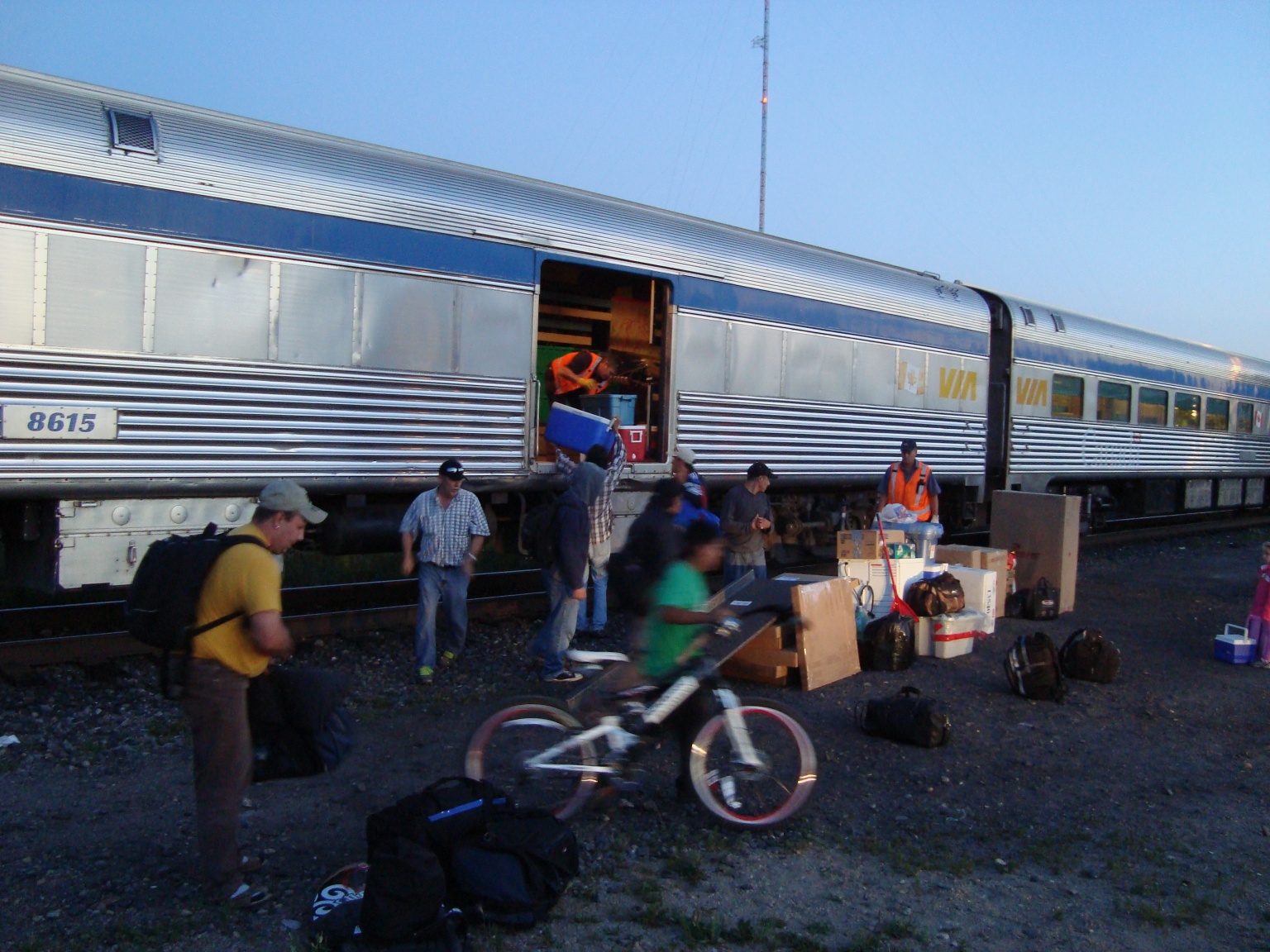
Stuff being unloaded from the baggage car at Armstrong Station- about two hours east of our exit at Flindt Landing.
____________________________
Catching The Train Back To Toronto:
The logistics were also a bit different at the other end of the trip. Instead of ending the trip at Little Caribou Road, about 6 km from Armstrong, we paddled to Collins at the north end of Collins Lake on the last morning. We were at the railway tracks, which pass through the non-reserve status Ojibwa settlement of perhaps 200 people by 8:30 a.m., waiting for the train’s 9:30 arrival.

The VIA stop at Collins
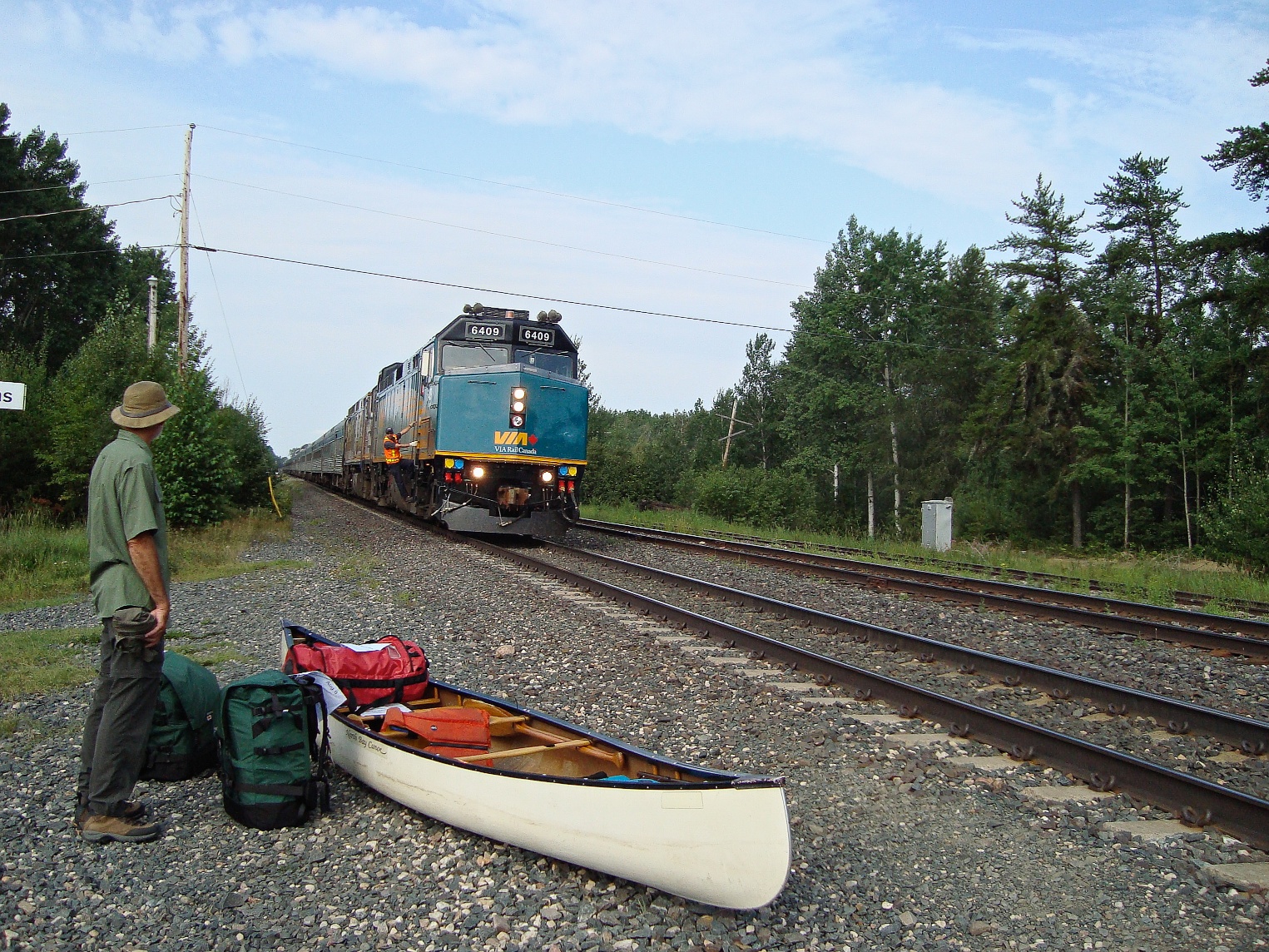
the eastbound VIA- just a little bit late!
We had arranged for the eastbound VIA train to pick us up on a Monday (August 8). (There are three eastbound trains passing through the Wabakimi area each week- Monday, Wednesday, and Friday.) [See the new schedule below!] Everything worked out just the way it was supposed to! Within thirty minutes of boarding, we were in the dining car having breakfast other than oatmeal for the first time in over two weeks. We were on our way home- and a day later, we would be!
VIA Schedule Eastbound From Savant Lake:

———————————————–
Flindt Landing – VIA Stop and Lodge
We got off the train at Flindt Landing around midnight. The lodge owner was up but was not expecting us. A confirmation call by me a day or two before would have been a good idea! Someone cleared the cabin on the island quickly, and we had our home for the night.
At $80. – or was that $100.? – it was a bit steep for the ten hours we were there. However, the alternative – looking for a place to pitch our tent at midnight, either near the lodge or on the other side of the lake – was worse, especially since we had no information on actual camp spots that we could use.
Note: With the revised VIA schedule, you now arrive at Flindt Landing from the east in the morning (9:42), so the problem of accommodation is solved. You can paddle until you find a decent spot on Heathcote Lake. (See here for the new schedule.)

A satellite view of Flindt landing and the Lodge on the north side of the tracks. The guest cabins are on the small island and are accessed by a wooden bridge.
———————————————–
Day-by-day Posts
Check out the following posts for a day-by-day breakdown of rapids, campsites, and challenges faced:
- Days 1 and 2 – Down The Flindt River From the CN Tracks
- Days 3 and 4 – The Flindt and Ogoki Rivers (Wabakimi Lake)
- Days 5 and 6 – The Ogoki, the Palisade, and the Grayson Rivers
- Days 7 and 8 – The Grayson River and Whitewater Lake
- The Ogoki Lodge and The Beckwith Cabins: “All Things Must Pass”
- Days 9 and 10 – McKinley Bay To Smoothrock Lake
- Days 11 to 15 – From Smoothrock Lake To Collins Via the Boiling Sand R.


Hello,
thanks for sharing your trip experiences in Wabikimi and leaving this great resource for others.
I am wondering between the Flindt and Allenwater rivers, which you think would be the better choice for travelling south against current?
THank you very much!
Simon
Simon, it has been a while since we went down those two rivers! I am assuming you want to get back to the CN tracks at either Flindt Landing or Allanwater Bridge for a train connection. I think going up the Allanwater will be easier.
If you are coming from Kenoji Lake, you wouldn’t have to paddle the length of Wabakimi Lake to access the mouth of the Flindt. Also, the major 2023 wildfire along the lower Flindt will have destroyed some portage trails.
See here for a map – 2023 Flindt River Wildfire
The Allanwater escaped the worst of the 2023 fire. It is also a more scenic route with a couple of beautiful waterfalls along the way – Granite Falls and Brennan Falls.
Thanks for your reply!
We have run into some timeline changes and the canoe availability on the train means we can only take our canoes as far east as Allenwater. What we are proposing is to head down the Allenwater to the area around Brennan or Granite Lake and then turn around and head back up the Flindt to catch the train a week later at Flindt Landing.
Do you think that’s a good idea?
Simon
Simon, too bad about the train. We had a similar issue last summer and ended up postponing our trip down the Savant River for a month.
Re: your down the Allanwater/up the Flindt. I’d say one week is not enough if you were intending to paddle down to Wabakimi Lake and then west to the Flindt and upriver to Flindt Landing.
The route you outline looks doable. The stretch to Brennan Falls and back to the turn-off point to the Flindt is (about 60 km. I wonder what shape that almost 1-km. portage is in to get you to the Flindt. It may not have been used in years.
https://tinyurl.com/2yjutjke
Another option would be to get off at Savant Lake VIA stop (or drive there) and get shuttled to a Savant Lake put-in and over six days paddle to a take-out and shuttle back to Savant Lake VIA stop from Hwy 599. The two shuttles will add an extra cost. Since you are not in the Park there are no park fees. My Savant River report has info on a shuttle provider and on the route itself.
https://tinyurl.com/28ot57m5
I hope it all works out.
We ended up having a great trip in Wabikimi Park.
We went down stream from Allenwater Bridge through Brennan Lake to Brennan Falls and Granite Lake. Then we cut across to Smoothrock Lake through Elf Lake and a string of portages heading east. From Smoothrock we paddled up the Boiling Sand river and caught the train again at Collins. We were blessed with good weather and a few very calm days to move the kms needed and give us flexibility when the rain and wind wasn’t as kind on the last days of the trip. Doable in one week.
I would not suggest trying to head up stream against the current on the Allenwater River for anyone following this thread! Beautiful section of river, but wouldn’t be nearly as enjoyable going upstream.
Simon