
Table of Contents:
Day 1: Cashapampa to Llamacorral
Day 2 – Llamacorral to Taullapampa
Day 3: Taullapampa with Sentillo Climb
Day 4: Taullapampa – Punta Union – CS near Paria
Day 5: To Vaqueria and Pisco Base Camp Below Refugio Peru
- The Hike Up To Vaqueria
- Roadside of Route 106 at Vaqueria
- The View From Portacuelo Pass
- The Pisco Climb – Not A Technical One
- Our Campsite Above Cebollapampa
Day 6: Up To Pisco Moraine Camp
Day 7: Early Morning Climb Up Pisco’s Slopes & Back To Base Camp
Some Photos From The Top of Pisco
Day 8: Back To Huaraz
———–
Previous Post: Walking The Inca Trail To Machu Picchu
Related Post: Climbing Ishinca and Tocllaraju in Peru’s Cordillera Blanca
————
Getting To Huaraz -B. C. Cordillera Blanca!

One evening I was in Cuzco unpacking my Machu Picchu stuff and getting ready for the flight to Lima the next morning; twenty-four hours later I was at Olaza’s Bed and Breakfast in Huaraz, a town which serves as the main access point for trekkers and climbers heading into the Cordillera Blanca.

olazas Guesthouse huaraz – see here for TripAdvisor comments and score
Most of the day had been spent on the Movil Tours bus from Lima- eight hours and 400 or so kilometres along the desert coast and then up into the mountains.
Olaza’s proved to be a great place to stay in this town of 45,000- just a short walk from the downtown area and providing all the services you could want (laundry, kept luggage, and a great breakfast spot on the rooftop patio).

the view from the Olaza Guesthouse rooftop restaurant
[A brief note- Huaraz is not a pretty town. In May 1970, most of the city was destroyed and half of the town’s population was dead after a 7.7 earthquake (The Great Peruvian Earthquake) shook the entire region. Down the valley the town of Yungay was completely buried by the accompanying landslide; 20,000 inhabitants lost their lives.
What it lacks in beautiful old buildings, however, Huaraz more than makes up with its open and dynamic street life.

Huaraz and the Cordillera Blanca
The image below was taken from the Olaza Hostel rooftop. I was looking into the Cordillera Blanca and seeing just one of the dozens of 5500-meter peaks- next to the Himalayas, it is the most impressive rock collection in the world!

————
The Santa Cruz/Pisco Itinerary
I had two weeks to spend in the Parque Nacional Huascaran. The Park contains all of the Cordillera Blanca over 4000 meters in altitude. I hoped to do the following:
- the 40-kilometer Santa Cruz trek from Cashapampa, up the Quebrada Santa Cruz to Vaqueria
- a summit attempt of Nevado Pisco (5752 m),
- a climb of Nevado Ishinca (5530 m) and
- and standing on top of Tocllaraju (6034 m).
If all went well, Tocllaraju would be my first 20,000 feet + peak!

As I mentioned in Getting Real High in the Peruvian Andes, I used the services of Peruvian Andes Adventures and consider myself lucky to have picked them. If there are another half-dozen trekking outfits in Huaraz like this one run by the Morales family, then international trekkers are indeed well-served!

TripAdvisor comments and rating – see here
Since I had spent a week in the Cuzco region, I was already somewhat acclimatized to higher altitudes. This meant that I could start the Santa Cruz trek earlier than if I had just arrived from Toronto (90 m a.s.l.) via Lima (10 m a.s.l.)!
- Cusco is at 3340 meters and
- Huaraz is at 3050 meters above sea level.
————-
Day One: Cashapampa to Llamacorral

The Santa Cruz trek from Cashapampa to Punta Union

satellite map of Quebrada (Valley) Santa Cruz trek and the approach to Nevado Pisco after crossing the Portaceulo pass
——–
The Drive From Huaraz to Cashapampa
On May 20 we drove north down the Callejon de Huaylas (the valley between the Cordillera Negra and the Cordillera Blanca down which the Rio Santa flows). After a quick breakfast stop in a Caraz restaurant overlooking the Plaza de Armas, it was off to Cashapampa to meet our arriero and his four burros; they’d be carrying the camp gear and most of our personal stuff. There were only two clients in the group- a Montreal adventurer in his mid-20s and me in my mid-50s. To make it all happen we had Cesar Vargas, the guide; Cesar Henostrosa, the cook and assistant guide, as well as the Quechua arriero and his animals.

Cordillera Blanca – north section
We had hoped that one or more trekkers would join the group- and bring down the per-person cost!- but it was not to be. We were amongst the first trekkers of the season- had we left in late June or July it would have been much easier to add an extra person or two. All in all, it was still a relative bargain. You can of course do the trek by yourself and spend even less but I will admit that it is a treat to walk with just a day pack on your back instead of everything, including your accommodation and cook gear and four or five days of food.
——–
Up The Santa Cruz Valley From Cashapampa

Santa Cruz trek map at the Cashapampa end of the trip
Cashapampa, the start point of the trek, sits at 2800 meters. The goal for the first day was to hike up the canyon to Llamacorral (3750 m), where we would set up our tents in the meadow. The Rio Santa Cruz is never far away as you walk the trail and there is a closed-in feel to the first few kilometers.

on the first stretch of the Santa Cruz hike the trail follows the Rio Santa Cruz on the right

narrow passage of the trail up the Santa Cruz valley- in early 2012 a landslide in this area blocked the way and the trail was closed while park workers cleared the rubble
——–
Llamacoral Campsite
After four hours of walking, we were at Llamacorral and set up camp. The donkeys get to take it easy until the next morning and forage for anything green to nibble on.

burros at Llamacorral after walking up from Cashapampa on Day One of our hike to Vaqueria

at Llamacorral looking up the Quebrada Santa Cruz at the end of our first day in the Cordillera Blanca
We each had our own two-man mountaineering tent; there was also a cook/dining tent and a toilet tent set up by the crew. They were already up when we walked up to Llamacorral in the late afternoon, with the sun’s warmth already gone because of the steep walls of the valley.

tents at Llamacorral in the Quebrada Santa Cruz- the blue one on the right was the cook/dining tent

looking up the Quebrada Santa Cruz from Llamacorral
—————
Day 2 – Llamacorral to Taullapampa
Things opened up on the second day as we made our way up to Taullipampa with an early afternoon side trip which took us towards Alpamayo Base Camp and gave us some great views of the peak and of the valley below.

approaching Laguna Jatuncocha in the morning of Day Two on the morning of Day Two

Quebrada Santa Cruz above Laguna Jatuncocha

Artesenraju from the trail to Alpamayo base camp – Santa Cruz side trail

The view of Alpamayo from the side trail from the Quebrada Santa Cruz
We camped at Taullapampa (4250m) at the end of Day Two. Sometimes during the night, the donkeys decided to go back home to Cashapampa so we ended up spending an extra day here while the arriero fetched them!
—————
Day 3: Taullapampa with Sentillo Climb

Days 2 and 3 Taullapampa CS ,Taulliraju,Punta Union, and Sentillo
We took the opportunity for a bit of extra acclimatization and climbed to the top of a 5000 m peak called Sentillo on the south side of the valley and were rewarded with fantastic views.

on the top of Sentillo above the Santa Cruz valley with the peak of Nevado Taulluraju providing a crown!
And here is a photo of our campsite at Taullapampa about 800 m below from the top of Sentillo. The tents are on the top left of the image:

the view of our camp at Taullapampa (top left-hand corner) from Sentillo peak
From our Sentillo vantage point, we could clearly see the next section of our hike. In the image below you can see the trail zig-zag its way from the bottom middle all the way up to a point on the ridge. That point would be Punta Union, the high point of the actual trek at 4750m.

Nevado Taulluraju and the switchback trail over Punta Union
Back down on the valley floor, the view was a bit different! Here is a shot of Taulluraju with the laguna itself hidden from sight –

Rio Santa Cruz with Nevado Taulluraju in the background and our tent site in the middle right

the Rio Santa Cruz flowing towards Cashapampa from Taullipampa
—————
Day 4: Taullapampa – Punta Union – CS near Paria
On Day Four we left the Quebrada Santa Cruz via the pass at Punta Union and walked down the slopes to the Hauripampa Valley. Following this valley would take us to the endpoint at Vaqueria, where a vehicle would pick us up the next morning. But first, more stunning views-

the Quebrada Santa Cruz looking west towards Cashapamapa from the trail up to Punta Union pass

our four burros heading up to Punta Union pass with all the gear- the arriero and Cesar Vargas, the guide, follow behind

onwards and upwards on a pretty good trail

a last look back at Nevado Taulluraju from Punta Union

a section of the trail just below Punta Union

Punta Union with Quebrada Santa Cruz down below- you can see Laguna Jatuncocha down the valley
And then it is down to a new valley! Along the way the trail passes a few small lakes like this one-

Laguna below Punta Union on the Huaripampa side
Cesar el cocinero has as always raced ahead of us so by the time we pass the small laguna we see him up ahead in a meadow with the lunch spread all ready for us. All I can say is if you have Cesar as your camp cook you just know that you will eat well-

Cesar at the lunch stop below the pass at Punta Union

a beautiful scene to contemplate over lunch

Down From Punta Union towards Vaqueria
Eventually, we walked past the camping area at Paria but did not camp there; instead, we camped just a bit further down the valley

Paria in the Huaripampa Valley on the way to Vaqueria
The vegetation was becoming more and more lush as we lost altitude; soon we were walking through stands of quenua-

the trail framed by quenua trees with their characteristic reddish-brown bark
—————
Day 5 – To Vaqueria and Pisco Base Camp
The Hike Up To Vaqueria

satellite view of Vaqueria, Route 106 and last section of Santa Cruz trek
Signs that we were not far from people and small settlements started popping up. The sight of grazing sheep became more common-

grazing sheep in the Huaripampa Valley
I was surprised to see two children- a brother and sister- on their way to school the next morning. I did a tourist no-no and reached into my pocket for the candies that Cesar had included with the day’s snack pack and offered them to the kids. They took them shyly and- having put the candies away!- continued on their path.

two Quechua children stare into the lens of the candy-giving gringo

The sloping sides of the valley showed signs of intensive cultivation-

the trail cuts across the hillside with cultivated patches of land clearly visible
And then a sign that we were not far from the end of our Santa Cruz hike-

Vaqueria- the end point- this way!
———
Roadside of Route 106 at Vaqueria
After a bit of uphill to get out of the valley, we were standing by the side of Route 106, the road that would take us over the Portacuelo Pass and, after a four-day climbing trip to Nevado Pisco, back to the main highway and Huaraz. (See the map at the start of this post for the total picture!)

checking out the gear in front of a building on the side of Route 106 at Vaqueria
Our wait for the transfer vehicle from Huaraz would not be long; it was perhaps 45 minutes after we arrived that it pulled up, with plenty of room for our gear as well as with new supplies for the 3 1/2 days we’d be climbing Pisco. We also gave a ride to a Swedish hiker Angelika. When the young Montrealer bailed out of our Tocllaraju climb because of a bad cold/flu, she took his place for the Pisco climb.

same, same ….but different! the Santa Cruz map at the Vaqueria end of the 45 km hike
———
The View From Portacuelo Pass

Vaqueria – Route 106- Portacuelo Pass-Pisco Campsite – Nevado Pisco
The ride up to the pass and down to the trailhead to Pisco was stunning. Portacuelo Pass sits at 4850m and from there you can look way west past the Llanganuco Lagunas. The following images will show it better than my words can tell!

looking down the switchbacks to the bottom of the valley and then through Cebollapampa up towards Refugio Peru and our climbing objective, Nevado Pisco, the third peak from the left

a shot from near the top of Portacuelo Pass another view of the Lagunas and of Nevado Pisco and its neighbours

the two Llanganuco lakes sit below us as we take in the view near the top of Portacuelo Pass- Route 106 to Yungay continues on the right hand side of the lakes

satellite view with Portacuelo Pass, the Llanganuco Lagunas, and Nevado Pisco
As we looked north towards Pisco, Cesar the guide explained how it would all unfold.
- We would get to our base camp (4600 meters) by mid-afternoon this day;
- the next day we would move up to the Moraine Camp (4900m). It is on the bottom left-hand corner of the following image;
- finally, on the third day, we would make a very early (2:00 a.m.) start from the Moraine Camp and be on top of Pisco (5750m) by nine or ten o’clock.
- By 5 p.m. we would be back in Huaraz celebrating our excellent adventure!
Here again, is the terrain to be covered-
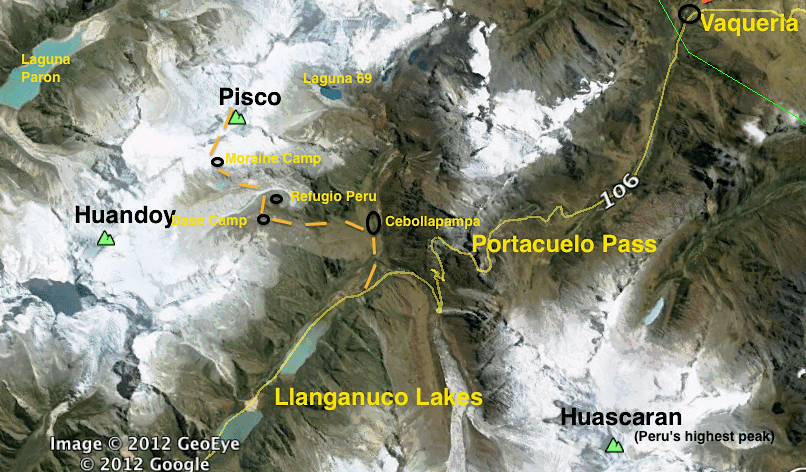
the road from Vaqueria to Portacuelo and then down to the trailhead for Pisco, which goes through Cebollapampa to the Refugio Peru
———
The Pisco Climb – Not Technical
Pisco is not a technical climb but the proper gear and the right attitude is still required; it is also a fact that global warming is changing the faces of the glaciers throughout the Andes and Pisco is no exception. What the guides once knew is disappearing; what is appearing-i.e. objective hazards like crevasses – is unknown and must be treated with caution. Given that my concept of literacy involves reading black marks on paper or screen, I am always happy to be in the hands of a capable guide like Cesar Vargas, who has spent a lifetime in the mountains and has developed the literacy skills necessary to read the snow and rock that we move across.

Nevado Pisco from Portacuelo- the Normal Route takes you up the ramp from left to right to the summit
———
Our Day 5 Campsite Above Below Refugio Peru

Pisco campsite below Refugio Peru
Our first Pisco day had a simple objective- get up to the meadow below Pisco and below the Refugio Peru. It involved walking through Cebollapampa and then up a clearly defined trail to our campsite.
Amazingly, when we got there we were the only climbing party tenting! It was May 24; I guess we were a bit early in the season. Apparently during prime time in July and August, the meadow is jammed with tents. I’m glad I missed it!

the meadow which would serve as base camp for our summit of Pisco a day and a half later

the Refugio Peru on a ridge above the meadow where we camped- the summit of Pisco beacons above the Refugio and the trails lead there
—————
Day 6: Up To Pisco Moraine Camp 4900m

Cesar the cook presides over the breakfast table on a sunny morning before we head up to Moraine Camp-

airing out my goose-down bag for a while before it is time to pack for the trip to Moraine Camp
After lunch we broke camp and, with Tony as our porter to carry some extra gear, made our way to the Moraine Camp at 4900m, a three-hour climb over the moraine and scree fields. By 4:30 we were there and looking back:

looking into the sunset from Pisco Moraine Camp

supper at the Moraine Camp before turning in early- we’d be getting up at 1:30 a.m.
—————
Day 7: Very Early Morning Climb Up Pisco
I don’t have any pix from the time we crawled into our sleeping bags to after sunrise as we made our way up the side of Pisco. The idea behind the early start is to get the snow while it is at its coldest and hardest; ideally, you should be coming down from your summit by eight or nine in the morning without sinking knee-deep into the soft snow with each step you take.

no new snowfall means a clearly visible path leads up to the top-
Once the sun came out it was actually pretty warm; I stripped down to my base layer and a thin soft shell. We were roped up from the moment we stepped onto the snow until we returned to the scree after our descent.

approaching the summit of Pisco on a beautiful Sunday morning

looking towards Huandoy from Pisco as we approach the top
———–
Some Photos From The Top of Pisco
And then we were there- WOW! High fives all around. Taking in stupendous views. It was a Sunday morning when people go to church and I was thinking- “This is my church!” This is where I acknowledge my gratitude for being alive, for being a part of it all.

Cesar and Angelika on Pisco summit- nine a.m. Sunday morning

Cesar Vargas and I on Pisco summit- it always feels great to meet the challenge and succeed


view from the summit of Pisco- at the bottom right of the image is the end of Laguna Paron- or is it Laguna 69?

Pisco and surrounding peaks

incredible views all around
After a glorious chunk of time up on the summit- fuelling up, relaxing, taking snapshots, enjoying the sun’s warmth and having Cesar name the various peaks yet again, socializing with a party of six Brits that came up a few minutes later- it was time to go back down.
Our porter Tony had already dismantled the camp and gone down with most of the stuff, so it would not take too long to get back to the base camp in the pasture below the Refugio Peru. We now got to see the crevasses and other potential problem spots that we had walked by in the dark on the way up.

interesting shapes on the way down from Pisco summit
The Brits were good enough to pose on the summit as I pointed my camera up at them.

Climbers on the Pisco summit celebrate their place in the world!
Finally, that moment when we make the transition from mountaineering to hiking! We untied the rope from our harnesses, took off the crampons and the harnesses, and got ready for the quick descent to base camp.

our guide Cesar Vargas at the end of the roped-together part of the return trip to base camp Pisco
A quick stop at the Moraine Camp to pick up the rest of the gear and we were good to go!

pit stop at Pisco’s Moraine Camp to pick up the remaining gear
Cesar the cook had a light lunch ready for us when we arrived- lots of soup and some pasta concoction that filled us up. Given that we hadn’t really slept that much the night before it was time for a mid-afternoon nap. here is the view from my Macpac tent just before the fly was zipped shut-

The rest of this day was spent relaxing and eating and reminiscing- and talking a little about the next instalment of our Peruvian Andes adventure, our upcoming visit to the Quebrada Ishinca and the peaks we would do there.
—————-
Day 8: Back To Huaraz
The next morning we had an easy walk down to Cebollapampa and the road (Route 106) which would take us past the Lagunas Llanganuco and back up the valley to Huaraz.

we walked through Cibollapampa on our way back to the rendezvous point on the side of Route 106
Some parties camp at Cebollapampa before making the ascent up to the plateau below the Refugio Peru or while waiting for vehicles to arrive the next day. We were just passing through-

3900 m- about 1500 m higher than Machu Picchu and 2150 m less than our final objective, Tocllaraju
A bonus for us was some time spent along the shores of the two Llanganuco lakes on the way back to Highway 5N.

Lagunas Llanganuco from Cibollapampa trailhead

same view but a bit different!

looking back towards Cebollapampa with Route 106 on the left and the Llanganuco Lagunas on the right
One more shot and we’ll end the first leg of our mountain adventure in the Cordillera Blanca! We are on the rooftop patio of Olaza’s Bed and Breakfast enjoying a brief respite before we take off again- a Swede, a Quebecois and a Torontonian sharing a common interest and hanging out in Huaraz, Peru!

After a day of rest in Huaraz- sleeping in until past 7:00 a.m. (!) and then getting laundry done, visiting the pretty decent local museum, looking for gifts for the peeps back home, going back once more to the California Cafe- I was ready for the last chapter of my Andes climbing trip.
Annika and I were going to the Ishinca Valley with two peaks in our sights- Ishinca itself as a warm-up summit and then Tocllaraju, looming over the valley at 6034m. The two Cesars were in charge of the trip- just fine by me, given the great job they had done on the first ten-day section described above.
—————-


What mastery in capturing the spectacular landscape of the Peruvian Andes! I am grateful to have stumbled upon your inspiring blog as I am trying to recount my own trip six years ago, from which I have too few photos and only one journal to help me conjure up memories and descriptions. Right now I am describing the boulder field between the first moraine wall and the glacier’s edge. Your photos are helpful–and stunning! Not to mention, I now have the correct spelling of Cebollapampa. Write on friend! Keep on getting high! :)
Anna, what an effusive “thumbs up”. I was sure it was spam! It is nice to hear that my pix brought back some of the wonder of your journey. I think about going back to Huaraz and the Cordillera Blanca. As you perhaps noticed from my recent posts, I am deep into canoeing the Canadian Shield- maximum altitude 400 meters – but I am happy to report I’m still getting high! I wish the same for you. :)