
Table of Contents:
- Why Machu Picchu Is Special
- Getting To Machu Picchu – Optional Ways
- Day 1: The Adventure Begins
- Day 2: Up And Over The Highest Points of the Hike
- Day 3: Mostly Downhill With Incredible Ruins
- Day 4: Intipunku and Machu Picchu
- If You Want To Hike the Inca Trail

Previous Post: Walking In The Inca Heartland – Cusco and the Sacred Valley
————
Why Machu Picchu Is Special

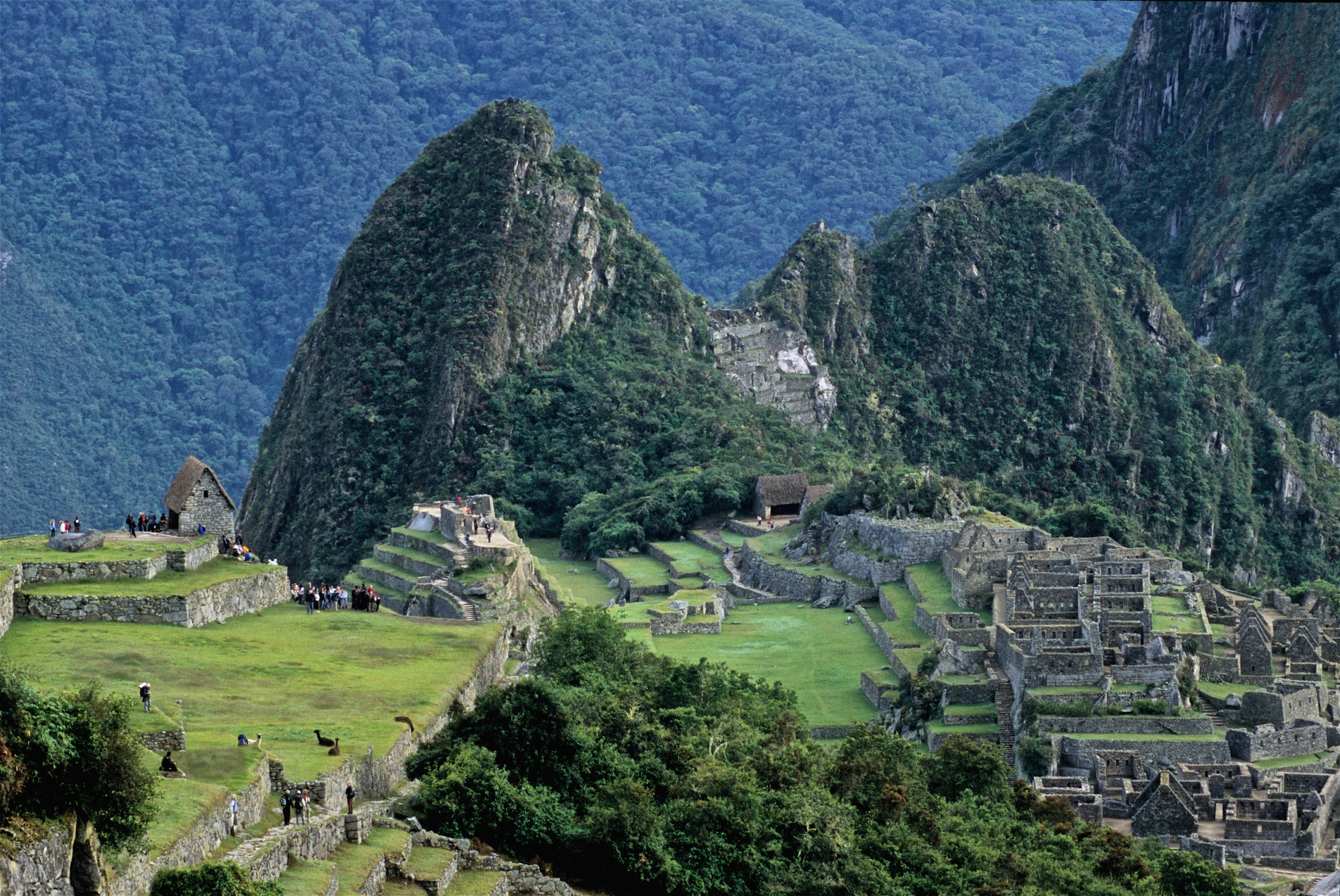
To walk down from the Gateway of the Sun (Inti Punku) to the site of Machu Picchu is an incredible experience. Having been on the Inca Trail for three days you are now rewarded with the stunning ruins of a site built for the Sapa Inca Pachacuti in the mid-1400s as his private retreat from the bustle of the Inca capital at Cuzco- and then abandoned when the next emperor did not share the same desire to get away from it all. Abandoned and forgotten by all except those who lived nearby for almost 500 years, it would be “discovered” by an American archeologist, Hiram Bingham III, from Yale University in 1911.
These days this powerful ruler’s getaway spot in the Andes is South America’s #1 tourist destination. Pachacuti would be shocked by all the foot traffic!

Machu Picchu Satellite View – click here to see the “live” Google view and to zoom in
————
Getting To Machu Picchu – Optional Ways
If you want to see Machu Picchu, it should be noted right away that you do not need to hike the Inca Trail to do so. The easiest way to see it is by a day visit by train from Cuzco to the ruins via Pueblo Machu Picchu (aka Aguas Calientes). The town is at 2000 meters; the ruins themselves sit on a saddle between two mountain peaks at about 2400 meters. A bus ride up the switchback road to the ruins and you’re there.

the switchback road from Pueblo Machu Picchu up to the ruins
You could make it a bit more enjoyable by getting to Pueblo Machu Picchu the day before and staying at a guesthouse overnight; that way you would get up to the ruins long before the tour groups from Cuzco arrive. Or you could get a room at the Belmond Sanctuary Lodge, located not far from the entrance to the site. This way you could be sure of getting to the ruins even before the tourists started arriving from the town below! Check this link to see how much it will cost you!

“custodian” of the ruins!
Here is a graphic from the Yampu Tours website that very neatly and quickly encapsulates the entirety of the trek.

The nice thing about getting to Machu Picchu via the so-called Inca Trail is that walking past several other remarkable Inca ruins provides a context as well as a build-up for the ruins of Machu Picchu. You also get to experience the various ecological zones as you move up or down in altitude. And while you don’t have to be an elite athlete to do the hike, there are moments when you may wonder why you didn’t just take the train. Stopping for a moment to catch your breath and register another WOW vista provides the answer!
————
Day One: The Adventure Begins

a view of the Trail from the top of Dead Woman’s Pass (Abra de Huarmihuanusca), the highest point of the Trail at 4200 meters
The Inca Trail itself begins at Km 82 at the end of the road from Cuzco. Since the rail line to Pueblo Machu Picchu passes right by and is 82 kilometres from Cuzco at this point, that is the usual starting point, since most trekking companies bus their clients to the starting point. (There is another trailhead at Km 88 which is sometimes used by groups getting off the train if they don’t get off at Km 82. The two starting points eventually join.)

the road to the start of the Inca Trail at Km 82 from Cusco
Click here for a “live” Google Version of the above map if you want to zoom in or out.

the train for Machu Picchu on the banks of the Rio Urubamba not far from Km 82
The first thing to do is get your park entry ticket. In 2012 the cost was $93.- it was recently doubled after a fierce debate over pricing the ruins beyond the ability of many Peruvians to pay.

some of my fellow trekkers lining up to get their entry permits at Km. 82
And then it’s off! No need for a map; just follow the guide! (But click here for a decent map of the entire Inca Trail with many points along the way indicated.) The walk for the first day heads south along the banks of the Cusichaca River, which is flowing north into the Urubamba River.


looking back at a stretch of the trail on Day One

the terraces of Llactapata as seen from the Inca Trail near the Rio Cusichaca
After perhaps three hours of walking, we stopped for lunch. The cook team had pressed ahead of us so that when we arrived at the meadow lunch stop the eating tent was up and the food was ready. I was impressed with the quality of the meals they prepared and found that they made no fuss about catering to my vegetarian request.

trekkers chillin’ after lunch with the blue eating tent behind them
Before we got to the first day’s tent site the trail skirted the village of Huayllabamba. I had to chuckle when I saw this example of Quechua entrepreneurship –


Inca stonework serves as the path along long stretches of the trail and adds to the mystique of walking it
The group of trekkers I walked with were mostly English-speaking, with five from Canada, four from Ireland, two from England, and two from the USA. Supporting us was a team of perhaps 15 Peruvians – 2 guides, a cook crew, and the porters.

some of my trekking pals – there were thirteen of us in total with me being the only solo traveller-
————
Day Two: Up and Over the Highest Points of the Hike!
The second day, as the chart above makes clear, was the longest one and the one where we walked up and over the two highest points of the trek. This is where hiring a porter to carry the bulk of your gear becomes a brilliant idea! Of course, some are up to the challenge of carrying their own stuff – as did the American couple on the left of the group photo.

heading up to Dead Woman’s Pass at 4200 meters
After another great lunch and rehydration, it was time for another nap!

Our goal for the day was the campsite on the other side of the second major pass of the trek; we would be on the move for another five hours. On the way we passed this mega campground – I think it may be the one by the Rio Pacaymayo. I’m just glad I did the walk in mid-May and not in July or August.
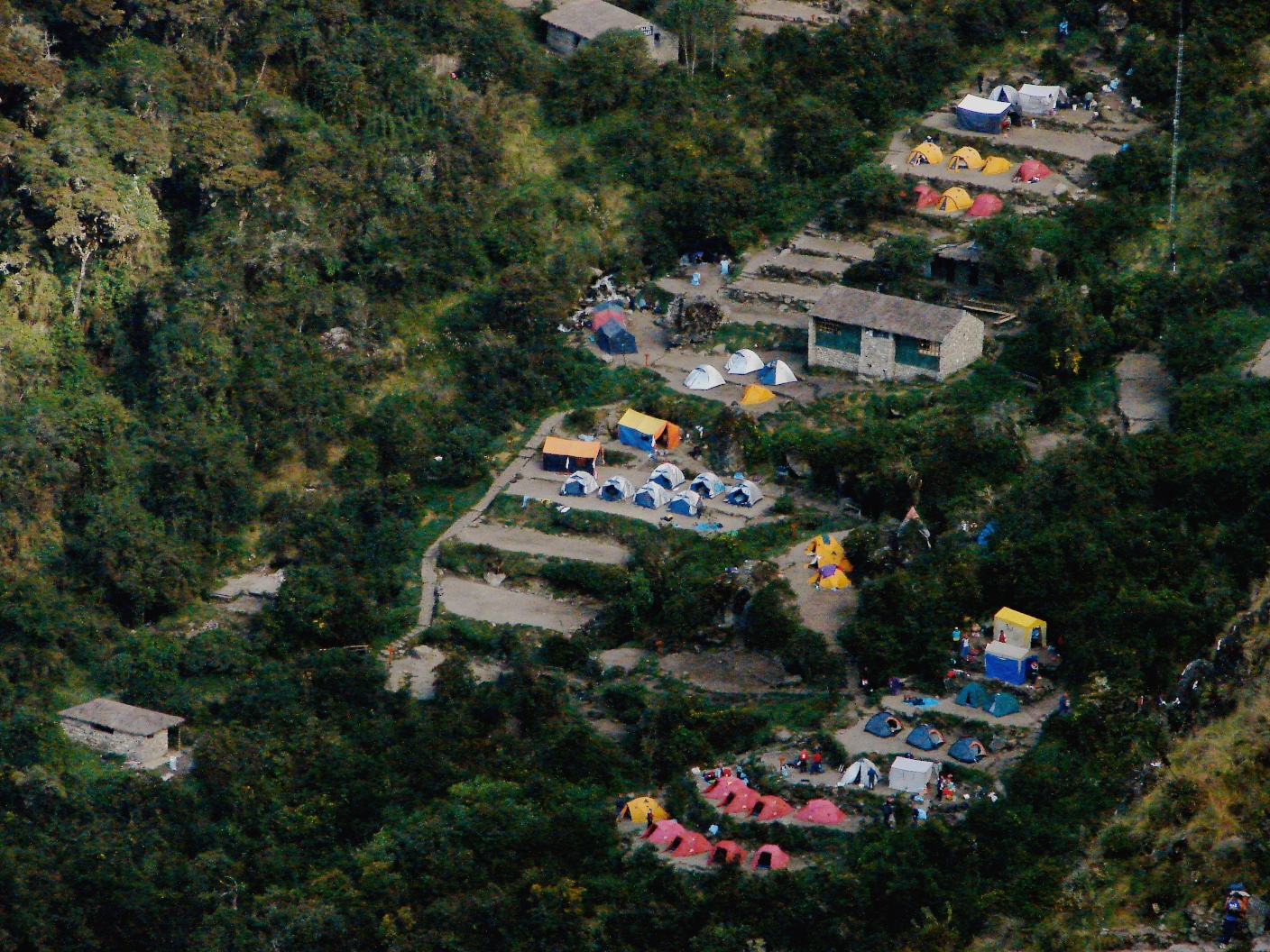
the sheer number of trekkers passing through requires an infrastructure to match- imagine the logistics of human waste and garbage disposal!
To get to the Sayamarca campsite we went over the Runku Raqay Pass and saw the ruins of a circular citadel overlooking the valley –

the circular ruins of Runkurakay
And then it was down to our campsite overlooking a valley. As you can see, the tents are pretty close together on our designated site –

the campsite at the end of Day Three of the Inca Trail
————
Day Three: Mostly Downhill With Incredible Ruins

Breakfast at the start of Day 3 on the Inca Trail
And then the day’s walk begins- an easy day that is, believe it or not, mostly downhill! We are not climbing up to Machu Picchu- we’re goin’ down!

At lunch, we took a moment for another group shot-
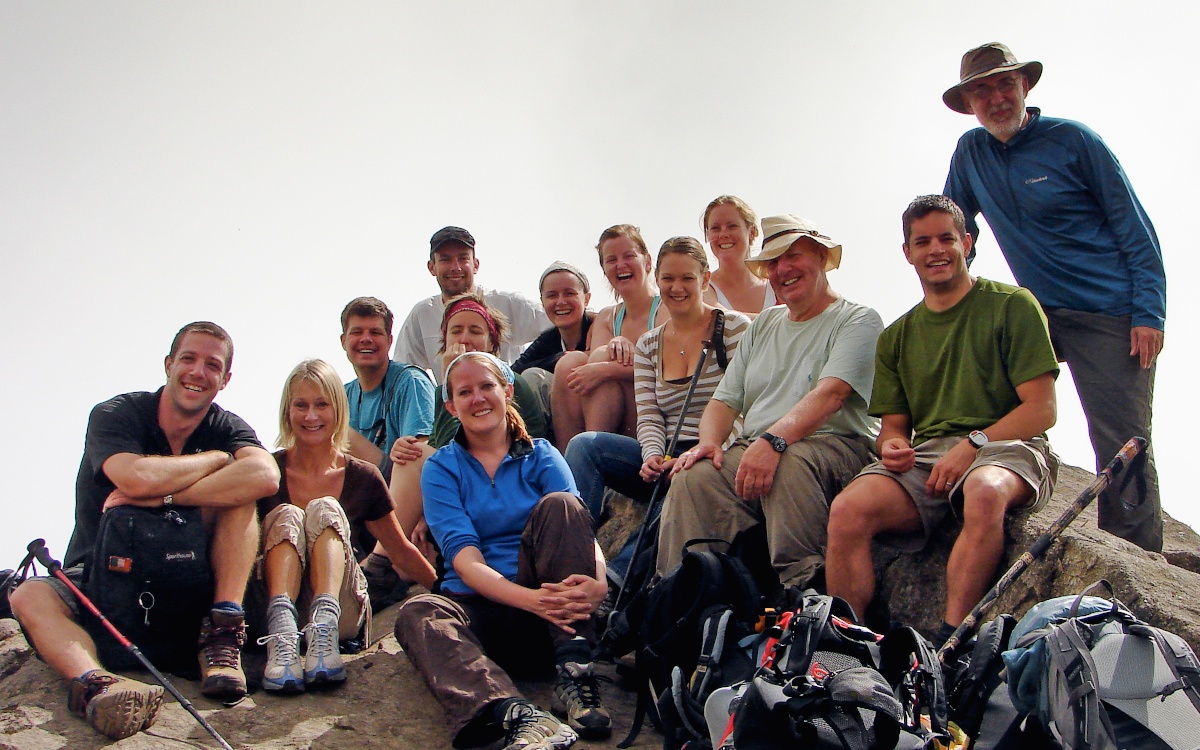
nothing like a day of trekking to put everyone in a good mood!
Given all the “youngsters” on the trek, I sometimes felt like a teacher on a field trip as I looked over folks half my age! Still, we had one thing in common – the magic of Machu Picchu!

the ruins of Puyupatamarca or “Town Above The Clouds”

more impressive ruins at the Puyupatamarca site
Here is something I usually forget that my camera can do- shoot videos. The camera I shot these pix with (a Sony H2) was my first digital camera! I come from a world of early 1980’s Nikon manual SLRs so the idea of shooting video hadn’t really clicked in yet. (To be honest, it still hasn’t!) But here it is – my first insertion of a video into a post!
There you go- I know, a tad lame. Like everything else, there is a learning curve and in this case, I was at the very start of it! The camera is in the right place but technique and composition need work.
This site, along with Winay Wayna and Machu Picchu, was one of the highlights of the trip from the point of view of the Inca ruins.

the mist adds to the magic of the “Town Above the Clouds”
And then it was onward- and downward. Some six-hundred-year-old staircases to negotiate and we made our way to the Day Three campsite located near the Trekker Hostel and Winay Wayna.

the Inca version of Led Zeppelin’s “Stairway to Heaven”!

another stretch of the trail- and another dramatic staircase
Early arrival at the campsite meant that we’d have extra time to visit the Winay Wayna site around the corner and sip on a drink or two at the Trekker Hostel. The tents were already up and I was pleased with the dramatic location the crew had secured for ours.

the view from my tent at the end of Day Three
Winay Wayna seems to have served as a bathing stop for people on the way to Machu Picchu; there is also an extensive agricultural terrace on the slope opposite the stone structures.

Winay Wayna structures from up above

standing within the upper level of Winay Wayna and looking at the valley below

a courtyard within the Winay Wayna complex

the agricultural terraces of Winay Wayna
Day Four: Intipunku and Machu Picchu
It had been early-ish to bed because we got up extra early to get past an Inca Trail permit check while it is still dark and then to Inti Punku for sunrise. This is the famous Gateway of the Sun and is the top of a slope from which you first see Machu Picchu. Well, that is the plan. Check out the scene when we got there-

pilgrims waiting at the Gateway of the Sun for Machu Picchu to appear
And where was Machu Picchu? Down there- underneath the clouds!

And here is the scene some fifteen minutes later from the same vantage point

Thirty minutes later, walking down the trail highlighted in red in the following picture and we were almost there-
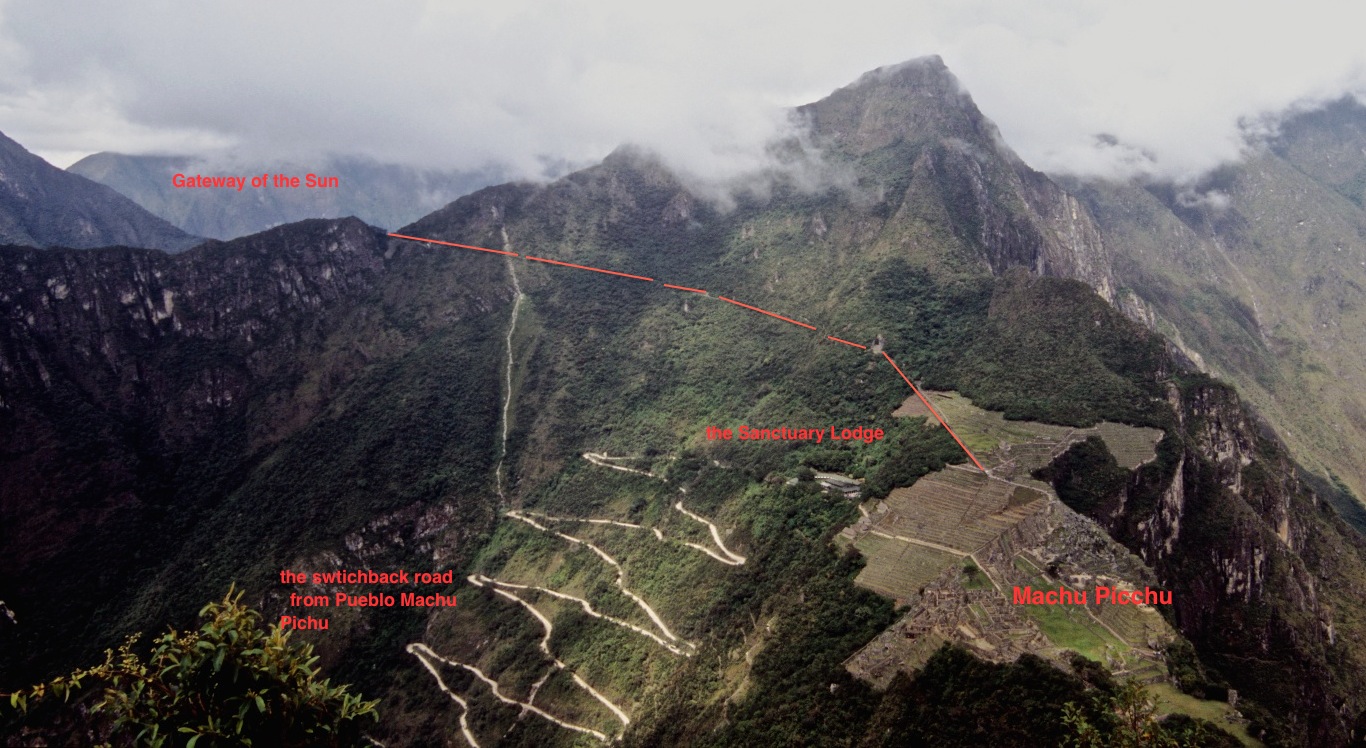
By 8:00 a.m. we are almost there- and a good thing too. The tour buses will start arriving at 9:30 or so and it will be nice to have the site mostly to ourselves for an hour or so- one of the rewards of coming down from the Intipunku on the Inca Trail!
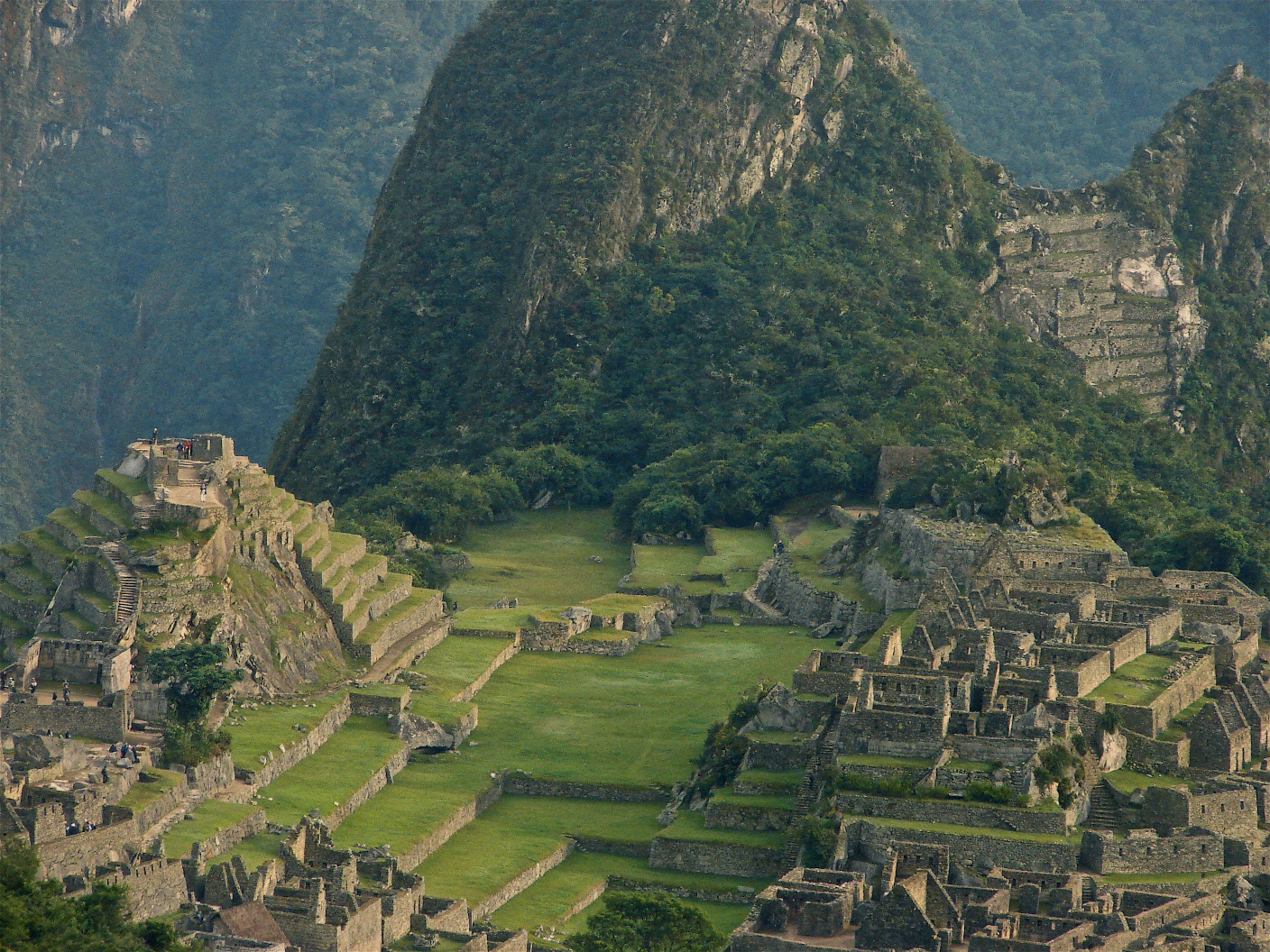
my telephoto lens has zoomed in on the heart of Machu Picchu but we still had a bit of walking to do!
And then we’re there.

Machu Picchu up close and vivid…it is 8:30 a.m. and Day Four of our walk. We’re here!
For a bit over an hour, I walked around the site- it was indeed still pretty free of groups other than the Trail walkers- and then decided that the peak I’m staring at in the above photo- it’s called Winay Picchu- needed to be climbed. The trail spirals its way around the side of the mountain to the top and gets a bit sketchy at times- but the lengths of thick wire attached to the mountain face make these stretches of the trail doable. Shades of the famous Via Ferrata in northern Italy!
We had until 2:00 p.m. at the site-in retrospect, too short a time. If I were to do this again, I’d arrange for a room in Pueblo Machu Picchu for that night so that I could stay longer on the first day and then return for another half day the next morning.

the central courtyard at Machu Picchu


The Intihuatana, the pyramid structure in the centre of the image, had a stone marker on the top used to determine the Winter Solstice


another view of Intihuatana, the pyramidal structure whose stone marker helped determine the timing of key festivals


The Royal Tomb beneath the Sun Temple
And here is a shot from Winay Picchu looking down at a couple from my trekking team. On the ridge, you can see the Gateway of the Sun that we had come down about five hours earlier.

And then – much too soon- it was time to come down from on high! Down From Winay Picchu summit to the saddle between the two peaks that the site of Machu Picchu itself was built on some 500 years ago, then way down via bus to Pueblo Machu Picchu, the boomtown whose sole purpose is obviously to cater to the 400,000 or so tourists who come through each year on the way to Pachacuti’s retreat.

the road from Aguas Calientes to Machu Picchu
Click here for an interactive Google map of the above image that you can play with!
Pueblo Machu Picchu is the gateway to Machu Picchu for those who arrive via train from Cusco or via other trekking routes. For some it is a quick day trip, arriving in the morning and leaving by 4 in the afternoon. Others overnight in the village and head up for the site as early as possible in the morning- either by bus or by foot (a tedious walk along the switchbacks that would have to be done before the busses started rolling).

one of the main streets of Pueblo Machu Picchu (or, as it used to be called, Aguas Calientes)

The Railway Station at Pueblo Machu Picchu- and the way back to Cuzco after the Inca Trail
————–
If You Want To Hike the Inca Trail:
If you’re interested in doing the Inca Trail yourself here is a good webpage to start with. It has a comprehensive list of dozens of trekking outfits keen to get your business; the site also highlights the main five or six. As I mentioned before, I went with SAS Travel and was 100% impressed with the service their people provided.
The typical 2012 cost is in the US$580. range. You may have to add on the park entrance fees- currently in the $95. range- if it is not included in your trekking company’s package. There is an additional fee if you want a porter to carry the bulk of the stuff you’ll be bringing. It is a worthwhile add-on since it leaves you with perhaps ten pounds (4.5 kg) on your back- your camera, some snacks and water, your rain jacket and pants, and a few other items you might need during the day. The porters are local subsistence farmers who use this job to get some hard cash. They earn about $15. a day.
Remember, if you want to do the three-night/four-day classic Inca Trail trek, you need to book months in advance. It is mid-April as I write this and SAS Travel is already fully booked until the beginning of September! Each company is allocated a certain number of places on the trail and once they fill those up, that’s it.
What to do if you are in Cusco and want to get a spot on the Inca Trail trek and can’t because all the permits have been long gone? Don’t despair. There are alternative treks that would also be worthwhile investments of your time and repay in dramatic views and a great trekking experience. Check out this National Geographic article – Top Six Alternative Routes To Machu Picchu – for some great suggestions!
Another possibility for those with less time – or less money! – is to do what john71 suggests in a Lonely Planet Thorntree Form post – click here for the details. I call it Machu Picchu By the Back Door. This Youtube video will give you a feel for the ride from Cusco to Santa Maria, and then the dirt road from Santa Maria to Santa Teresa and on to Hidroelectrica and finally the walk to Pueblo Machu Picchu (aka Aguas Calientes). Check out the ride on this Google map.
A New York Times Frugal Traveller article with the overly dramatic title “Conquering Machu Picchu The Cheap and Quick Way” (May 8, 2017) does have lots of good advice and all the most up-to-date prices for someone who only has one day to spend on a visit. Remember that Machu Picchu is lower in altitude than Cusco where you started from and the “conquering” metaphor becomes pretty silly!
See here for a nice bit of CNN video on the Machu Picchu site.
Buen Viaje!


Thank you for your great blog. I am leaving for a tour of Peru early August and walking the Inca Trail days 10-13. It looks fantastic and your photos are awesome. By the way I’m 70 years old but in fantastic shape and only hoping that the elevation won’t give me too much trouble.
Anne, I’m glad the pix and the write-up were of some use. You will come back with your own stories and some great pix that will excite someone else!
You’ll be okay with the elevation. Believe it or not, Cusco at 11, 200 feet (3400 m) is higher than Machu Picchu at about 7900 feet (2400 m) so if you’re okay in Cusco you should be fine on the trail. Just make sure you have two or three days to acclimatize in Cusco before you set off on the hike. Drink lots of fluids, take it easy for the first couple of days in Cusco, and maybe consider Diamox if you are really worried about it all.
Buen viaje!
Hello….just wanted to tell you how much I appreciated the pictures and commentary of your Inca trail hike. In fact your whole site is awesome. This hike was of interest to me as I did the hike from kilometer 88 wayyyyyyy back in 1973 and was able to do it with a friend and a map, no need for permits, groups, porters etc. We obtained a map in Lima or Cusco, can’t remember which and just headed out on an adventure. As my photos have more or less disappeared over the years it was immensely gratifying to relive the trip through your photos. Thank you for such a wonderful site! Happy Trails. Janie
Jane, thanks! My blog started as an attempt to make use all these digital images I had sitting on my hard drive. When I retired from a 35-year stint as a high school teacher, the blog was something I found I could apply whatever skills I had developed over the years. Getting emails like yours makes it all worthwhile!
I did the Inca Trail in 2007; it must have been an incredible adventure in 1973 before it became the groomed and managed hike it is now. Perhaps in 35 years someone will think the same about doing the Inca Trail in 2007! In the meanwhile, you and I will enjoy reliving our walks to the Sapa Inca Pachacuti’s weekend retreat at Machu Picchu as we look at the pics one more time.
We are planning a hiking trip to MP. Thank you so much for your blog. It is helping me visualize the experience better
Rona, nice to hear the post was of some use. Helping other people to visualize the walk – and to realize that they could do it too – were mostly why I put it together. It also helped me relive a fabulous walk through some great landscape and interesting history. I am sure you will enjoy yours just as much. If you upload your pix to a website, send me the link so I can take a look. Buen viaje!
Thank you for your detailed and wonderful posts on the Inca Trail/Machu Picchu! I’m taking on the challenge in April 2017 – any hiking tips? :)
Jan, it is February of 2017 and I just noticed I hadn’t responded! Just two more months and hopefully that adventure will more from your “to do” list to “been there, done that!” Happy trails!
Which lenses did you take for the Inca Trail and MP? I am a professional photographer doing the hike and am trying to decide what gear to take and which to leave behind.
Thanks!
Carol, those pix were taken in 2007! They were shot with my first digital camera ever, the Sony H2 with its 36-432 mm equivalent lens and its whopping 6 Mp sensor! https://www.dpreview.com/reviews/sonyh2
Like you I face the same question every time I set off. I am going to upper Mustang in Nepal next week and I am thinking of taking either my sony A6000 or my Sony A77 and four lenses. For each camera my main lens would be a Zeiss zoom that goes from 16mm to 70 or 80.
However, in the interests of lightening my carry load, a part of me is saying that the humble Fuji X20 I took on my Patagonia hike last year would do the job just fine.
No matter what camera you take, there are some great pix for you to walk into and frame! Enjoy your walk!