
Who Was Tappan Adney?
Since I uploaded this post in 2023, a new biography of Tappan Adney has been published. My thanks to his great-granddaughter, whose comment below prompted me to check out the Amazon site! Click here to access more info –

Tappan Adney Amazon site info
————–
Edwin Tappan Adney (July 13, 1868 – October 10, 1950), commonly known as Tappan Adney, was an American-Canadian artist, writer, and photographer. (source)
So begins the Wikipedia page providing a brief outline of Tappan Adney’s life and why he is still remembered 75 years later. It was the time he spent in Woodstock in New Brunswick’s St. John Valley that had the greatest impact on his life. In his early 20s, Adney befriended Peter Lewis Paul, a member of the Wolastoqiyik First Nation, and learned how to build canoes in the Wolastoqiyik way. [These “people of the beautiful river” are also known by their Mi’kmaq name Maliseet.] He would also learn the Wolastoqiyik language and become a strong advocate for their culture.
Adney died in 1950, leaving unfinished his life’s major project. As John McPhee writes in his The Survival of the Bark Canoe (click on the title to access a PDF file of the book) –
Adney so thoroughly dedicated himself to the preservation of knowledge of the bark canoe that he was still doing research, still getting ready to write the definitive book on the subject, when, having reached the age of eighty-one, he died. Over the next dozen years or so, Howard I. Chapelle, curator of transportation at the Smithsonian Institution, went through Adney’s hills of paper and ultimately wrote the book, calling it The Bark Canoes and Skin Boats of North America. (p.7)
The Adney/Chapelle book was finally published by the Smithsonian in 1964.

Along with the material for the eventual book, he constructed exact replica models of about 130 canoe and kayak styles and forms at a one-fourth or one-fifth scale. McPhee’s book includes a section on some of Adney’s models and traditional construction techniques.

Adney Wolastoqiyik (Maliseet) Decorated Canoe
Adney’s book and models remain the primary sources of information on the construction and development of the bark canoes of the Indigenous Peoples of Canada and the northern U.S., in particular the Anishinaabe (i.e. Algonkian) cultural family to which the Wolastoqiyik belong.
This Mariners’ Museum slide show presentation provides an introduction to a few of Adney’s canoe replicas. [The models are on display at the museum in Newport News, Virginia.]
Downloadable copies of the book are readily found online. See here for the Gutenberg site, where it is available in various file formats. The Internet Archive site also has copies for free download or to borrow.
———————
Adney’s Missinaibi Visit:

Missinaibi and Little Missinaibi Lakes – and rail access
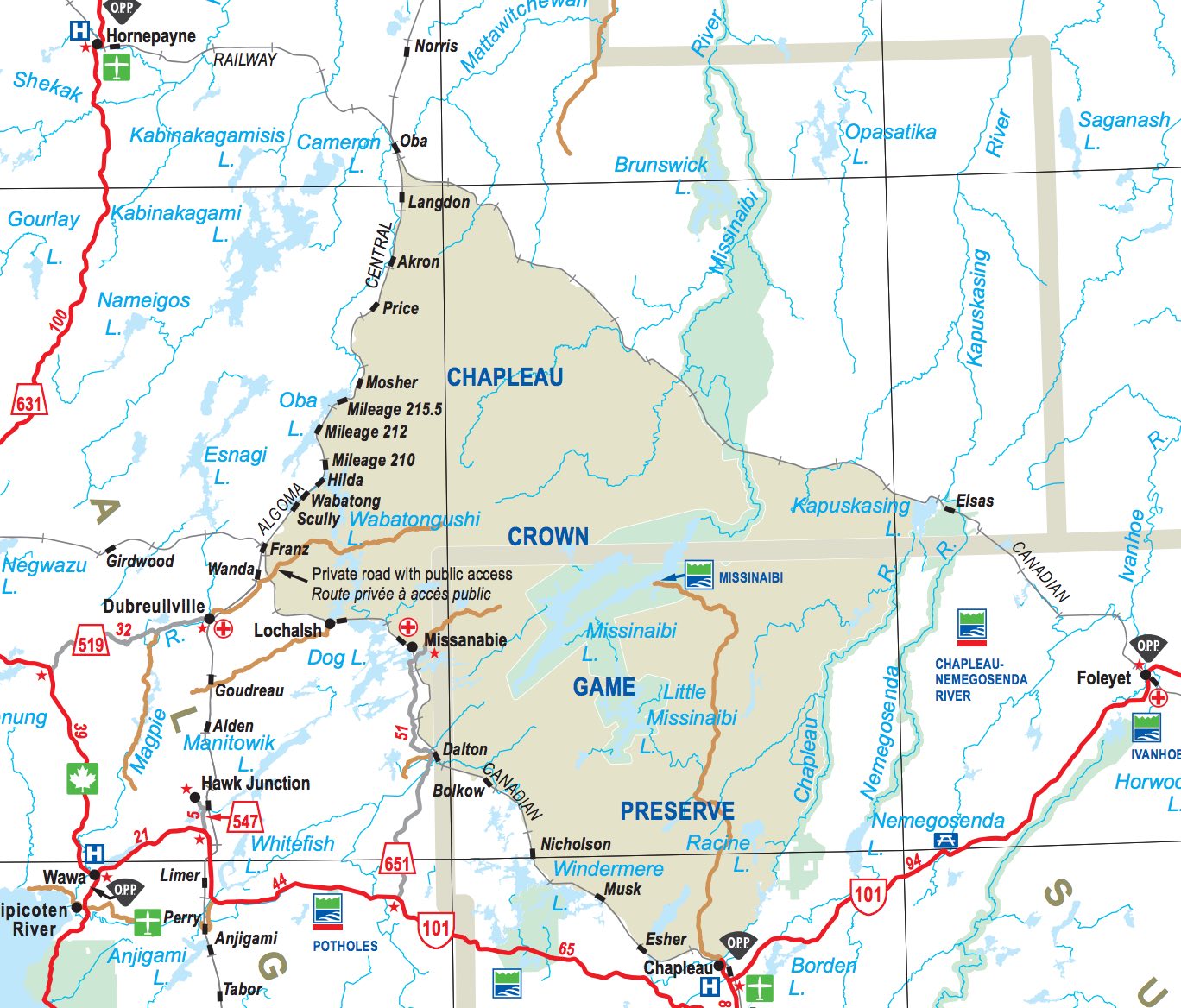
In 1930 a 62-year-old Adney spent some time in the Missinaibi region. Five years before the area framed by the CPR, Algoma Central, and CN tracks and the Chapleau River on its eastern side had been designated as the Chapleau Crown Game Preserve. His main motivation was undoubtedly to learn more about traditional Ojibwe and Cree canoe building from the local people who still remembered the old ways.

Adney map indicating Cree and Ojibwe areas in the Missinaibi region SW of James Bay
While I have yet to find possible journal entries he made about this trip, his sketchbook images and photographs are available online, thanks to Montreal’s McCord-Stewart Museum.

Other than his continued interest in birch bark canoe construction, he also visited some of the pictograph sites found in the Missinaibi area. With him, he had an Ojibwe and a Cree paddler as guides. Along the way, he made sketches of the images found at the rock painting sites. Receiving the most attention were the pictographs
- at Missinaibi Lake’s Fairy Point site,
- on the east side of Missinaibi Lake’s Whitefish Bay, and
- at two sites on nearby Little Missinaibi Lake.
These drawings and notes of the various sites are the oldest we have of Anishinaabe rock painting sites in northeast/north-central Ontario. Of these sites, Fairy Point is the most significant.
———————
The name Fairy Point comes from what was thought to be the English equivalent of the Ojibwe term maymaygweshiwuk, who were the mischievous elf-like creatures who lived in the dramatic vertical rock faces of lakes and rivers of the Canadian Shield. They acted as intermediaries who would connect the manitous with the petitioning shamans and vision questers who left their painted images as a part of the ritual connection.

Gelatin silver film negative Edwin Tappan Adney Fairy Point, Lake Missinabie, ON, 1930
As far back as 1875, Robert Bell of the Geological Survey of Canada used the English translation Fairy Point in his report of his route up the Missinaibi River and the Lake from Moose Factory and James Bay to his Michipicoten destination. It does seem strange that he makes no mention of the collection of pictographs at Fairy Point, given that they are one of the largest in northeast and north-central Ontario.

Gelatin silver film negative E.T. Adney Tip of Fairy Point, Lake Missinabie, ON, 1930

Gelatin silver film negative Edwin Tappan Adney, Rock paintings near the tip of Fairy Point, Lake Missinabie, ON, 1930
Fortunately, when it came to the pictographs, Tappan Adney would not be so silent – or so unimpressed. He seems to have spent a couple of days at the Fairy Point site, sketching the images which make up the various panels. As well, he took some photographs, including the ones above. They represent the oldest still existing- and perhaps first – visual records of the pictographs in the Missinaibi area.
The entire McCord-Stewart Museum collection of Adney sketches, photographs, and other artifacts (81 items in all, some going back to his time in the Klondike Gold Rush in the late 1890s) can be accessed here.
———————
What follows are individual pages from Adney’s sketchbook. Whenever possible, I also included photos of the same panel of images taken by my brother and me on our last visit in 2016.
The Moose and Stars Panel


Enlarged detail of B from the previous sketch – source

top section of Moose and Stars Panel

the bottom part of the Moose and Stars Pictograph Panel

Fairy Point – Moose and Stars Panel
———————


———————


continuing north – another Fairy Point pictgraph rock face

close up of previous pictographs
———————

———————


———————


approaching the north end of the Fairy Point pictograph site
———————
The Mishipeshu and Caribou Panel:


Gelatin silver film negative Edwin Tappan Adney Rock paintings – Caribou and Mishipeshu panel Fairy Point, Lake Missinabie, ON, 1930. source here

Fairy Point Mishipeshu and Caribou Panel

Fairy Point’s Mishipeshu and Caribou Panel –
For more on the Fairy Point pictographs and other sites on the lake, see the post below –
The nearby pictograph sites on Little Missinaibi Lake are covered in a second post –
S


Peter,
Great to hear from you again! And what a delightful way to be reminded of my article in the Fall 2017 edition of FORESTORY.
https://www.fhso.ca/media/forestory/FHSO_journ_vol_08_iss_2_fall_2017.pdf (pgs 21-26)
This is the first I’ve ever heard the name Tappan Adney. I look forward to reading your post, in its entirety, later this evening. My first cursory glance tells me that this article will be up to Ramblin’ Boy’s established standards!!
Best,
Garry
Garry, nice to hear from you! Thanks for the link to your Fairy Point article, an excellent read! I am going to insert a link to it in my Missinaibi Lake post.
Re: Adney. His name appears in a Thor Conway account of Little Missinaibi Lake’s Pothole site. I let it slip by for years until I stumbled into it again a couple of days ago while looking for some other Missinaibi-related material.
The link led me to the unexpected McCord-Stewart collection of Adney artifacts, including the sketchbook material. It was definitely a wow moment! His sketches are probably the oldest existing – and maybe the first – visual records of the Fairy Point and nearby sites.
Since then I have learned more about Adney’s lifelong work in preserving the knowledge of traditional birch bark canoe construction that would otherwise have been lost forever. There is more to explore and find out!
Hello to all, I am Tappan’s great-grand-daughter, Kimber Hawkey. I happened upon this page while looking at other information regarding Tappan. What a man with so many eclectic talents!
I hope that you have all heard about and been able to read the award-winning recent book that was finally published about him after many years of research and work by people such as Daryl Hunter, Jim Wheaton, Ted Behne, and finally Keith Helmuth who put it all together.
There is so much more to tell actually about his incredible life. Book: “Tappan Adney: From Birchbark Canoes to Indigenous Rights” https://www.amazon.com/Tappan-Adney-Birchbark-Canoes-Indigenous/dp/1773103148
Greetings to all who share his passions.
Thanks for bringing the book on Adney’s life and legacy to my attention! It came out a year after I uploaded the post. I’ve added a reference to it at the end of the post. I also ordered a copy for nighttime reading on an upcoming canoe trip!
Enjoy your reading! Another interesting thing to watch is a Canadian reality series that had a group of people re-enact the truly arduous journey to the Klondike. The producers used Tappan’s writings as a basis for the trip with voiceovers of someone reading his writings. It is truly incredible to see what people did and endured to try and strike it rich! The show is called: “Klondike: Quest For Gold”, and it was available on Amazon Video here in the U.S.: https://www.amazon.com/gp/video/detail/B01MAW4ZT1/ref=atv_hm_mys_c_4I2SRv_2_10
Ah, the Klondike! In the late 1970s a group of us took the boat from Port Hardy on Vancouver Island up to Skagway, walked the Chilkoot Trail to Bennett, took the train to Whitehorse, and paddled Hudson Bay Co.canoe rentals down the Yukon River to Dawson City. It was my first great adventure.
Pierre Burton’s 1958 epic account – Klondike: The Last Great Gold Rush, 1896-1899 – was the book that inspired the journey. Your video suggestion will be sure to evolke some great memories. Thanks.
Good morning Peter,
It’s been a while since we have directly communucated and it’s interesting that Fairy Point on “Big Miss“, a joy we both share from our canoeing history of experiences, has again become our facilitator.
With your permission, I’d like to link the FHSO [Forest History Society of Ontario] now the FHO [Forest History Ontario] article I wrote about Mary‘s Island and the “Pictographs of Missinnaibi Lake“. Written about my Junior Forest Ranger memories of the summer of 1967…I had just turned 17 … it has again stirred the “memory jar’ of what was to become best summer of my lifetime so far.
I look forward to your reply, my Friend.
Garry
P.s. should you ever find yourself enjoying the “Caledon Hills” please let me know and I’ll have a dram of Adam’s Ale chilled and awaiting for your consumption. /jgp
Gary, nice to hear from you!
Re: link. Absolutely. In fact, I had said I was going to do just that months ago. Apologies. My search just now at the FHSO website did not turn up the article. Please send the link.
Re; Caledon Hills. I will take you up on your offer one of these days! There are some great cyclig trails up there that I hav been wanting to ride and a slight detour to your place would be a bonus.