

Cordillera Huayhaush peaks
- My Previous Cordillera Blanca Trip
- Getting To Huaraz
- Lima Airport Overnight
- The Bus To Huaraz
- Some Background Info On Huaraz:
- Local Trekking/Mountaineering Agencies:
- Acclimatizing In and around Huaraz:
Our 15-Day HuayHuash Circuit Itinerary:
- Day 1 : Mini-Bus To Llamac: Our Trek Starting Point
- Day 2: to Quartelhuain Campsite at 4200 meters.
- Day 3: Over Paso Cacanon (4700) to Campsite at Laguna Mitucocha (4220)
- Day 4: Over Paso Carhuac (4650) to Campsite at Laguna Carhuacocha CS (4150)
- Day 5: Rest Day at Carhuacocha
- Day 6: over Siula Pass (4800) to CS at Laguna Carnicero (4300)
- Day 7: Portachuelo de Huayhuash (4750) to CS above Lago Viconga (4480)
- Day 8:Pumarinri Summit )5465)/Paso Cuyuc (5000) to CS at Quebrada Huanacpatay (4300)
- Day 9: Paso Cerro Antonio (4788) to CS at Quebrada Calinca (Cutatambo) 4100
- Day 10: CS at Quebrada Calinca (Cutatambo) 4100
- Day 11 down Calinca to Huatllapamup to Huatiac 4350 camp
- Day 12 Punta Tapush 4750 high point / Laguna Susucocha Cashpapampa 4500 camp
- Day 13: Diablo Mudo Summit (5223) to CS at Laguna Jahuacocha (4150)
- Day 14: CS at Laguna Jahuacocha (4150)
- Day 15 return to Llamac and bus back to Huaraz (3300)
Maps/Trip Reports/Guide Books/Trekking Agencies:
Buyer Beware! (Huayhuash Tours Are Not All The Same)
Final note – what happened to my photos and videos?
—————–

Blanca y Huayhuash
My Previous Trip To the Ancash Region
After a three-year absence, it was good to be back in Huaraz in Peru’s Ancash region. On my previous two-week visit to the Cordillera Blanca, I had done the following:
- the Quebrada Santa Cruz trek
- and climbs of Pisco, Ishinca, and Tocllaraju.

Tocllaraju High Camp – social hour
They included my first 20,000 ft / 6000 m summit, Nevado Tocllaraju, at the top of the Quebrada Ishinca.
It had been a great experience, and now I was back for more!

A trekker’s Peru – the key points! Click here for a “live” map you can zoom in on.
—————–
Getting To Huaraz:
Lima Airport Overnight

Lima’s international airport (Jorge Chavez) is a very modern facility and a great introduction to Peru
Getting to Huaraz is pretty simple.
Start with a direct flight – in my case, from Toronto to Lima. (I avoid non-direct flights when I have all sorts of specialized gear in my duffel – and this time, I had a climbing harness, ice axe, helmet, crampons, and an extra pair of heavier leather mountaineering boots along. I figure a direct flight means one or two fewer chances for the baggage handlers to screw up.)
The plane arrived in Lima around 1:00 a.m. My trekking partner and I ended up catching some sleep at the airport, camping out in a corner on the second floor along with a dozen other travellers.
Cruz del Sur bus To Huaraz
 When it got light, we washed up, had breakfast, and headed to the Cruz del Sur bus depot by taxi to catch the 9:00 a.m. bus. (Click here for info on dependable bus companies in Peru.) By 4:00, we were in Huaraz, having driven along the scenic Pacific coast road (the Pan-American highway) for 200 km and then up into the mountains and to Huaraz for the final 200 km. Also on board were two American trekkers from Colorado who would be joining us.
There to greet us at the bus station were the Morales brothers, the owners of the company we had booked our trek with.
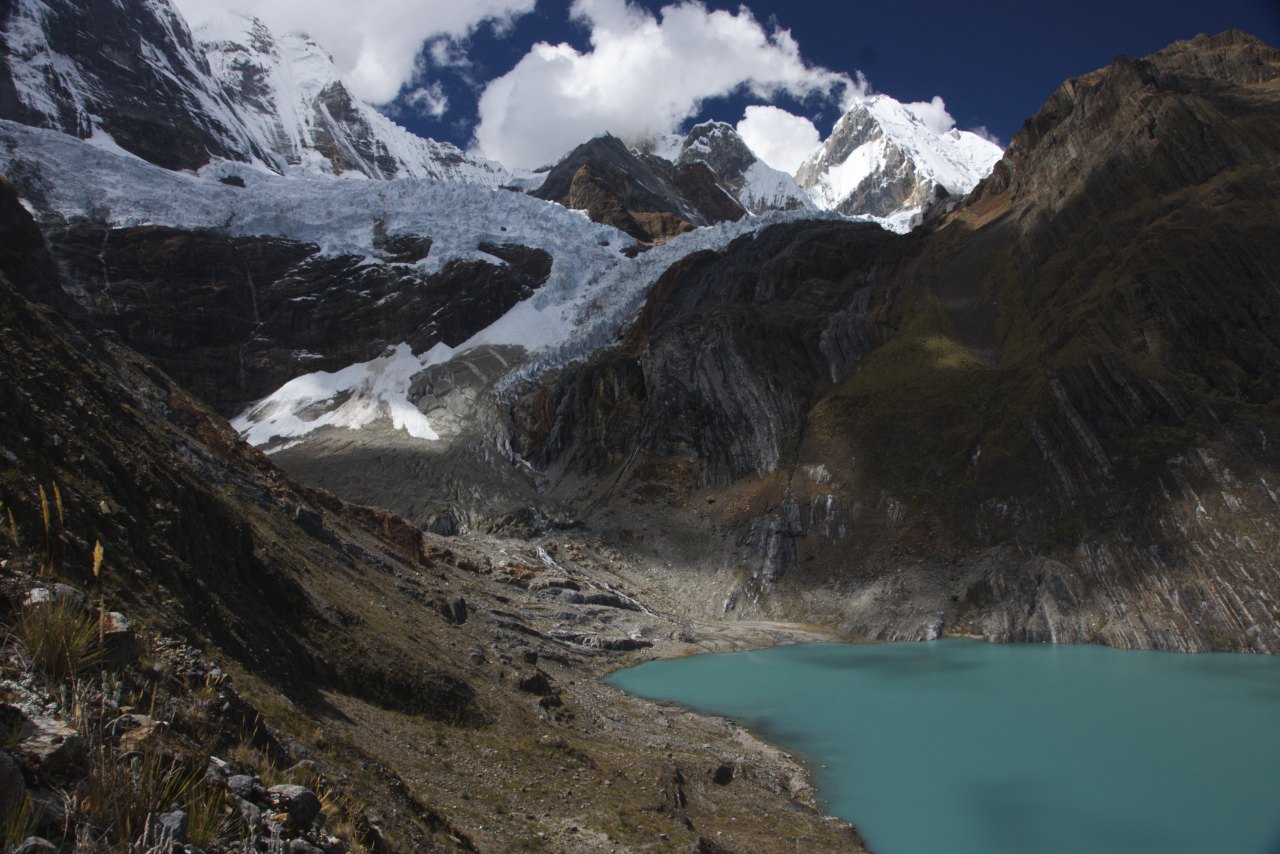
Huayhuash view by Laguna Jahuacocha on our last day of the 15-day trek
—————–
Some Background Info On Huaraz:
Huaraz is a lively town of about 50,000, which has become the #1 trekking and climbing center in South America. It is in the middle of the most extensive collection of 6000+ meter (19,685 ft for the metrically challenged) peaks outside the Himalayas (22 according to the Lonely Planet count). If you recall that Denali is North America’s only 6000 m peak, you’ll get the picture! The Cordillera Blanca includes Alpamayo, considered the prettiest mountain in the world by some, and Peru’s highest peak, Huascaran Sur (6768m).

looking east into the Cordillera Blanca from Olaza’s rooftop patio in Huaraz
Huaraz is not a pretty town, devastated by an earthquake in 1970 that wiped out whole towns further north like Yungay, which was destroyed, and where 20,000 inhabitants died.)
These days, Huaraz has everything a hiker and climber could want – an infrastructure of guides, arrieros, and supplies. It also has some excellent local companies that put it all together at a reasonable price.
—————–
Local Trekking/Mountaineering Agencies:
Several local agencies offer hikes, treks, and climbs. Picking one that actually delivers on its promises can be difficult. Check out the following two web pages to get a feel for what is available and what you should look for before you pick one.
- A website named Things To Do lists ten Huaraz-based agencies that you can use as a starting point in your research for a reliable agency. Amazingly, all ten receive a 5 on 5! The writer may be basing the list on TripAdvisor ratings.
- The Zen Travellers blog has an excellent write-up on trekking in the Huaraz region. The section on local tour agencies has the title “Choosing A Local Agency – The Wild West,” which points out what to look for.
- Checking out a recent copy of Lonely Planet’s Peru Guidebook should provide you with dependable information and reviews of the main agencies.
The Huaraz agency I chose was Peruvian Andes Adventures. It was the same company I had used for my Quebrada Santa Cruz trek with a summit of Pisco three years previously. The Morales family runs the company from an office around the corner from the Morales Guesthouse, where I began and ended this trip. See here for their current TripAdvisor score!

Our guide would be Manuel Vargas, the younger brother of Cesar, who had been my guide for the 2007 adventure. Manuel would prove to be an excellent group leader. Amazingly enough, Cesar Henostrosa, the cocinero extraordinaire (and capable assistant guide) from 2007, would also be coming along again. I felt right at home!
My destination for this trek was to the south of Huaraz – the smaller, more isolated, and less-visited Cordillera Huayhuash. (A quick pronunciation tip – it is pronounced Why-wash. And yes, you’ll know why at the end of your trek! )

Satellite shot of the Cordillera Huayhuash – most of the circuit is in the image.
—————–
Acclimatizing In and around Huaraz:
Before setting off on the trek, we spent two days in Huaraz, adapting to its 3000 m/10,000 ft. altitude. One day we did a hill walk above Huaraz and were rewarded with fantastic views on a clear day. The second day we did the classic acclimatization hike – the one up to Laguna Churup. This was all very helpful and meant that the Diamox container could remain closed. Taking the time to let your body acclimatize is always the best approach.

Laguna Churup view on our acclimatization hike
—————–
Our 15-Day HuayHuash Circuit Itinerary:
Now it was time for the trek itself. The satellite image above shows you the mini-range of Huayhuash in the shape of a T; it is about 30 kilometers from one end to the other, with six peaks over 6000 meters and a couple of dozen over 5000. It’s like walking in the Mount Everest region in Sagarmatha National Park but without the prayer flags!
Most of the 125-km long trek is on trails above 4000m, and above the tree line, so you have a very stark mountain scenery.
- It is much more of a commitment than, let’s say, hiking in the Monte Fitz Roy area near El Chaltén in Argentina’s Patagonia.
- It is more physically demanding than southern Chile’s eight-to-ten-day Torres del Paine Circuit.
However, the reward is even more stunning scenery – and nobody is there! It is not everyone’s cup of tea, but if you enjoy the idea of “leaving” civilization behind while donkeys carry your gear for a couple of weeks of wandering along incredible mountain trails, look no further! It also won’t hurt to have a bit of experience camping and hiking elsewhere, although I am sure that newbie trekkers have done it and done it just fine.

Going over the day-by-day itinerary, I saw that we would sleep over 4000m for all but the first night of the trip. What was also good to see was the built-in safety factor of walking high during the day and sleeping low that night.
A quick look at altitudes listed on the day-by-day chart above will show that we almost always slept at a lower altitude than that day’s high point, which was usually a pass but included two summits. Most days involved five or six hours of walking; we were generally in the dining tent by 4:00 p.m. for tea and biscuits.

Our approximate route is marked in black. Peruvian Soul is an adventure travel company that offers a shorter trek in the Huayhuash. See here for its 2022 trip choices – the Huayhuash is no longer one of them.

—————–
Llamac: Our Trek Starting Point
Until the early 2000s, when the road to Llamac was finished, the Huayhuash trek usually began 25 km further away from the large village of Chiquian. Our trek started with a ride to the new trailhead at Llamac in a mini-bus with room for the seven clients, the two guides and cook and his assistant and a lot of tenting equipment and food. Our campsite was on the edge of the soccer field just across the river from the village. The World Cup was going on at the time, and some of us went with the guide to a house in the village where we watched Holland defeat Uruguay 3-2!

At Llamac, we met the arrieros (muleteers) and their ten burros. They would carry the bulk of our stuff; we would walk with day packs containing rain gear, cameras, and a water bottle.
I appreciated the fact that I did not have to do this particular trek unsupported, weighed down by all the things you’d need to bring. That may be one advantage of being 23 instead of my 62 – you would just go ahead and do the trek by yourself anyway! And, to be honest, you’d do just fine!
—————–
Day Two: to Quartelhuain Campsite at 4200 meters.

Quartelhuain – Day 2’s campsite (4200 m)/dining tent is on the left, cook tent on the right
The Day 2 walk from Llamac to Quartelhuain is along a gravel mining road. It makes for a good easy first day of walking – and I’m sure it gives the arrieros time to make adjustments before the trek begins in earnest.
Some trekking groups just drive to the Quartelhuain camping area and set up their first camp there. That cuts a day off the trek length.

Donkey blankets at the end of the day Day 2 camp – villagers hiring out their donkeys get $10. a day per burro – a significant cash infusion during the winter months.
—————–
Day 3: Over Paso Cacanon (4700) to Campsite at Laguna Mitucocha (4220)
On our third morning out, we came to Paso Canacon, our first pass. A condor was flying overhead as we took in the grand view at the top. It made everything feel just perfect.

Day 3 – over the first pass…the trail was usually very clear and obvious

mandatory tent-door-as-frame shot Day 3 camp…peaks everywhere!
—————–
Day 4: Over Paso Carhuac (4650) to Campsite at Laguna Carhuacocha CS (4150)

one of the three or four shepherd’s huts above Carhuacocha on Day 4

Laguna Carhuacocha – days 4 and 5 campsite on the shore of the lake with Yerupaja dominating the view – click here for a live Google map

the Carhuacocha campsite – overcast but stunning view
—————–
Day 5: Rest Day at Carhuacocha

the small laguna above Carhuacocha – we visited on our free day

the lads relaxing after our scramble up to the Laguna

glacial snow in the mist above our lunch spot

the view on getting ready to leave camp the next day
From our campamento on the east end of Laguna Carhuacocha, we had a superb view of the heart of the Huayhuash range. In the photo above (and the one below), we see (from left to right):
- Siula Grande (6344 m),
- Yerupaja (Peru’s second-highest at 6617m),
- El Toro,
- Jirishanca (6126m) and (I think)
- Jirishanca Chico.
Quite the starting line-up for any league!

—————–
Day 6: over Siula Pass (4800) to CS at Laguna Carnicero (4300)

just before noon above the two lakes on the way to Siula Pass

same view as above – portrait mode
Most trail maps show two ways of getting to the Carnicero campsite from Laguna Carhuacocha. This more moderate route involves heading east from the Laguna and then gradually up and over to the camp or a more demanding route over a higher pass (Siula). I am glad we got to experience the truly stunning views that the second option provides. The arrieros did take their animals the easier way, and the camp was all set up when we got there – including tea in the dining tent. Being on an organized trek has its benefits!

lunch spot on the other side of Siula Pass on the way to our Laguna Carnicero Campsite
—————–
Day 7: Portachuelo de Huayhuash (4750) to CS above Lago Viconga (4480)

on the way to the hot springs
At the hot springs in the early afternoon of Day 7, we got our first full-body shower/wash of the trip. Otherwise, in true Nepalese trekking style, bowls of hot water were placed before our tent doors first thing every morning. I did go through the basic cleaning ritual, but I’ll admit I was more interested in the cup of hot tea that came shortly afterward.
—————–
Day 8:Pumarinri Summit )5465)/Paso Cuyuc (5000) to CS at Quebrada Huanacpatay (4300)

the view from Pumarinri – one massive WOW

me on top of Pumarinri – bringing along the mountaineering gear was worth it, especially since the donkeys carried it most of the time!

rappelling down Pumarinri

Descending Pumarinri July 13 1:30
—————–
Day 9: Paso Cerro Antonio (4788) to CS at Quebrada Calinca (Cutatambo) 4100
The two days we spent at the top of the Calinca Valley were a major bonus; most groups do not include this side trek as a part of the package. We got to the ridge above Laguna Jarau for lunch and then spent a couple of hours making our way to the camp at the top of the Quebrada Calinca.
We used the two days there to do laundry and relax – but the main attraction was a pilgrimage up to Laguna Sarapococha to see firsthand the setting of Joe Simpson’s epic tale of human survival as told in the mountaineering classic Touching The Void.
Touching the Void:

Our terrain for Days 9 & 10 – the Setting of Touching The Void. Click here to zoom in

at the Paso Cerro Antonio – the South view of Siula Grande with a slice of Laguna Jurau visible in the foreground and Laguna Sarapococha, a dot in the left middle of the image
Simpson and his partner Simon Yates were two British climbers who came up to this area in 1985 to tackle the last major unclimbed objective in the range. This was the West face of Siula Grande, whose peak is lost in the clouds in the picture above.
They did succeed in their attempt – but as they say, “When you get to the top, you’re only halfway there!” The story of how they – and in particular Joe, since the book is his first-person narrative – got back down makes it one of the must-read mountaineering books.

on the moraine on the other side of Laguna Sarapococha, contemplating Touching the Void

Siula Grande Satellite image – with Laguna Sarapococha viewpoint to the west

I purchased a copy of the book in Nepal a few years ago. By this point in the trip, I had read it a second time to refresh my memory on some details. During the two weeks we were on the trek, almost everyone borrowed the book for a couple of days, agreeing it was one compelling read.

the Simpson/Bates campsite was on the right side of the Laguna – to get to Siula, they moved up on the glacier and then moved up and to the right
—————–
Day 10: CS at Quebrada Calinca (Cutatambo) 4100

looking into the eating tent – breakfast!

A working dog – part of the arrieros’ team
—————–
Day 13: Diablo Mudo Summit (5223) to CS at Laguna Jahuacocha (4150)

a stretch to Diablo Mudo summit
A bonus of this particular version of the trek was the option of trying to summit Pumarinri and Diablo Mudo, two non-technical peaks. While they still required our respect and experience in handling rope and ice axe while moving up, they were in the P.D. range of difficulty – that is, un peu difficile, but not overly. They were fun to do and gave us lots of great shots. (If you’re wondering just where those supposedly great shots are, please see the very end of this post for the explanation!)

Our campsite for Days 13 and 14 – Laguna Jahuacocha area – click here for the zoomable map.
Day 13 was a big day, beginning with a 4:00 a.m. breakfast, the just-after-dawn approach to Diablo Mudo. After enjoying the views from the summit, we made our way to the camping area at Laguna Jahuacocha. For the first time, we were not the only party with our tents set up; four other groups were there.
—————–
Day 14: CS at Laguna Jahuacocha (4150)
On our second day at Jahuacocha, some in our group walked up to Sambuya Pass and looked down the other side to see where we had walked up from Llamac about two weeks previously. I contented myself with a lazy day and a walk up toward the top of Laguna Solteracocha. The image below shows how far I got.

my tent at Laguna Jahuacocha with the peaks behind

creek bed colours – the stream running from Laguna Jahuacocha

pasture wall passed by as we walked up to the higher lake on our off day

the end of the lake above Laguna Jahuacocha

the mist descends on Laguna Jahuacocha not far from our tents on the last night of the trek
—————–
Maps:
The best map available (2004, the second edition of a 1:50000 scale Cordillera Huayhuash) is one that Brad Johnson’s Peaks and Places Publishing put out. Unfortunately, it is no longer available from the publisher (see the notice here), but I saw a few copies at Cafe Andino when I was there. I think it was going for $25. Unless you plan on doing the circuit on your own (i.e. unsupported by arrieros and burros), it may be unnecessary. You’ll be with guides who have done the circuit often! Then again, you could just get the map and benefit from all the detail it provides.

Google Earth has come a long way since I did this trek in 2012. It no longer requires a dedicated app and can be accessed in Chrome. Check out the satellite view of the trek route. You get some excellent 3D perspective. Also, check out the Microsoft Bing Aerial View for occasionally better images.
Trip Reports:
Summitpost.org has an interesting (but dated) page on the Cordillera Huayhuash that is worth checking out for basic info. You can find it here. Also at the site is a trip report with some great pix.
Guide Books:

Other than trip reports and images posted on the net, there isn’t much information on Huayhuash. I did buy Climbs and Treks in the Cordillera Huayhuash of Peru (2006) by Jeremy Frimer from High Col Press. It was overkill, given we were just trekking, but it has helpful background information. You can check out the publisher here – but unfortunately, the free preview is no longer available. The book may have been updated in 2016.
Trekking Agencies:
If the Cordillera Huayhuash sounds like a space in which you’d like to spend a couple of weeks as a part of an organized group, then check out these adventure travel companies for typical itineraries that will give you an idea of what is involved –

Brad Johnson’s book on the Cordillera Blanca – complete with excellent 3D renditions of the various valleys leading up to the multiple peaks – is now a part of my library. Johnson also has a trekking/climbing company called Peaks and Places. A Cordillera Huayhuash Circuit is one of the trips offered; prices are relatively close to those of Exodus. Click here to see the trip details. It isn’t cheap – but you will be well taken care of and have the best guides.

G-Adventures – once known as Gap Adventures until The Gap Clothing Company decided to send its lawyers after this Canadian company – has a Cordillera Huayhuash offering. Trekking the Huayhuash Circuit is a thirteen-day trip starting and ending in Lima, with eight actual days in the Huayhuash area and one in Huaraz. See here for the full itinerary.
I winced when I read the brochure description of their trekking on Day 7. It describes the walk from Laguna Carhuacocha over the Siula Pass this way –
Today it is a long, gradual climb out of the valley with the impressive Mt Yerupaja as a beautiful backdrop. Followed by a steep, rocky climb up to the Siula Pass, made famous by Joe Simpson on his fateful hike. Descend down to the campsite for the night Huayhuash campsite.
We know that Joe wasn’t out for a “fateful hike”! He was on the other side of the mountain, far away from the pass.

A few trekking agencies will take you to the lake where the Simpson camp was. The following is one of them!

I did the trek with Peruvian Andes Adventures, a company owned and run by the Morales family out of Huaraz.
The agency was not mentioned in the guidebooks that I usually consult. It was also the pre-TripAdvisor era, so I was apprehensive when I first used their services for a 2007 trekking/climbing holiday in the Cordillera Blanca.
I’ve been raving about their A+ quality ever since that first trip. If you want to see how trip advisor contributors have rated the agency over the past few years, check out this webpage here.
Initially, just two of us signed up for the trip – at about $2200. each. Luckily for us, six more people had joined by the time we left for Llamac, including two Brits who had signed up the day before! The trip price per person tumbled down to $1350.! The Peruvian Andes trip info can be found here.
(The prices are from 2010. They will definitely be higher in 2017 – but they will be fair! Of all your trekking options in South America, Huaraz represents the best value. However, it is not Nepal so if you want it cheap, head for the Annapurna Circuit or the Khumbu!)

Other Peruvian adventure travel companies get good reviews for the trips they put together. A website named Andeantravelweb lists a number of them. While the website is a very useful resource, there is still no mention of Peruvian Andes Adventure! Perhaps there is a price to pay to make the recommended list.

One agency I looked at briefly, Explorandes, offered something called The Huayhuash Range Trek, a seven-day package with about five spent in the Huayhuash. It is no longer available. Now on offer is a nine-day Best of Huayhuash of which five days are spent in the Huayhuash region. No price is listed; it will obviously depend on how many trekkers the trip attracts.
Curious to better understand the Explorandes offering, I took the itinerary and mapped out the Explorandes route in orange. The actual trekking days are Day 4 to Day 9, and as the map makes clear, the term “best” to describe this route is clearly an overstatement! Compare it with the Peruvian Andes route that we did, and you can appreciate the difference – but of course, we spent 14 days on our trek compared to the 5 that Explorandes does. It all comes down to how keen you are.

The thin broken black line on the map above is the route we took on our walk around Huayhuash.
N.B. The first three days of the Explorandes trip are spent on acclimatization trips out of Huaraz. I am puzzled by the day spent driving north to the Llanganuco Lakes. It is four hours there and back, and while the lakes are pretty, you’d be better served with some walking in the hills above Huaraz or up to Lago Charup and then coming back down in the afternoon to your hostal. Day 4 is spent driving to the trailhead at Queropalca. The trek begins on the morning of Day 5.
—————–
Buyer Beware!
In the end, you’ll have to consider the various itineraries and the trip length and decide which one fits best with your budget, time frame, and interests. Not all trips billed as “Huayhuash Circuit” are equal! As I mentioned before, our trek itinerary included route choices that other trekking companies often do not have:
- the high route to Laguna Carcinero from Laguna Carhuacocha on Day 6;
- the chance to summit two non-technical peaks (Pumarinri and Diablo Mudo);
- and taking the side trail over Paso Cerro Antonio to the top of the Quebrada Calinca, where we spent two nights and had a chance to walk up to Laguna Sarapococha on a “rest” day.

the Huayhuash Circuit map – the usual in red and our adaptations in black
The Wikiloc site has a few Huayhuash tracks; the following one comes closest to the route we did with Peruvian Andes. We walked the road from Llamac to Quartelhuain on Day 2 and climbed Pumarinri. Click on the image below to access the satellite view –

Powered by Wikiloc
The GPX tracks for the above Wikiloc route are available here in my Dropbox folder. Note! To open the file as a GPX, you need to delete the .txt ending. Then it will work fine!
—————–
Final note – what happened to my photos and videos?
It shouldn’t have happened, but I have lost all 600+ raw image files of my Huayhuash trip! I had a computer crash before I had saved them to an external hard drive backup. Unfortunately, I had already deleted them from the camera memory card.
I stitched this post together from emails I had sent to people with image attachments and a few pix I had posted on Flickr or put in my desktop picture folder. Nothing like lugging a 3-pound DSLR around for three weeks and then having to accept the motley collection of 269 kb picture files I have used here. I am sure there is a message in there somewhere. Maybe it is this: You must go back to the Huayhuash right now and get those pictures!
I’ll see you on the trail…
Let me know if you’ve done the circuit more recently than in 2010 and what it is like. If you send me the link to your photos, I will put it here so readers can see the trail in 2023.


What are brillliant blog of your experience! Thank you for sharing! I am going to South America next month, very inspiring. :)
Ah, lucky you! The Huayhuash in mid- May should be a great place to be! Enjoy the views and the company you’re keeping as you walk around the majestic peaks.
Thanks for the great info :) I travel to Peru in June 5 weeks , Starting in Huayhuash, since different areas of Cordelia Blanca. Will try to do some mountain peaks.
Huaraz as the base camp and the Cordilleras Blanca and Huayhuash nearby make for a great combination. You’ll be there at just the right time of the year. Buen viaje!
Oops.
You can delete that last comment.
LINKED to your terrific trip report from this page:
http://besthike.wordpress.com/2013/06/17/huayhuash-circuit-peru-2/
You have no idea how often I have visited your site over the years for ideas on what to do next! I see you have migrated all the info to wordpress. It looks good!
THANKS
A work in progress — the WordPress migration.
I’m looking at the Indian Himalaya next. After some North American hiking this summer.
I’m from Calgary, by the way.
Trekking gets replaced by canoe tripping here in Ontario – but from 2000 to 2006 as an Alpine Club of Canada member I was flying into Calgary each summer for a couple of weeks of low-grade mountaineering – the Wapta Traverse, the Clemenceau Icefield out of the Grassi Hut, the Purcells…I’ve got pix sitting on some hard drive somewhere but have yet to turn them into posts! All except for the post on the Kain Hut and the Bugaboos, which has got to be one of the more magical spots on the planet. So many beautiful places – and so little time!
Awesome Post! Thanks so much for all the info. Is there a time of year that you would recommend the trek? Would it be possible in late Dec/early Jan?
That would be about the worst time to go! Try June through August or September for the best weather and clear skies. Definitely worth doing. Your Dates fit in better with southern Patagonia. See my Torres del Paine post for an intro. Happy trekking wherever you go!
Thank you so much for sharing the information and your experience at Huayhuash, a place I hope to trek (as well as Blanca) within the next few years (I’m a mere 60 yrs old). Met a German couple while I was in Peru in 2005 that had just returned from Huayhuash. Their camera images were stunning! Ironically, I met them at a newly formed hostel on the traditional culture Tequile Island in the middle of Lake Titicaca (reminded me of Appalachia where my family grew up without propane or electricity). The German couple was doing the initial Lake Titicaca kayak trip between 3 islands. Thing was, you had to start early at be to at destination island by 2pm, as the winds kicked up after that to 30-40 mph every afternoon. Nothing like a bit of survival kayaking on the world’s highest lake, eh?
Of note, one thing the German photographer told me was to get my photo cards burned to DVD at the end of every day. Even the smallest villages have enterprising young teenagers who are hot to use their skills and make some money. Amazing moment was when I stepped into a place where a college aged young man had his laptop plugged into the jukebox – this guy had every song Stevie Ray Vaughn recorded out in the middle of nowhere in Peru! That is magic indeed and such experiences keep us travelling!
Cheers
Bill in Roswell, GA
Always good to hear younger guys dreaming about the next hiking adventure! I think I was 59 when I did the Huayhuash. Going with an organized trekking group makes it much easier – I cannot imagine dealing with all the logistics and vehicle shuttles involved on my own and being with a knowledgeable guide certainly adds to the experience.
Not sure how necessary it is to make duplicates of your photos at the end of every day. I guess if you are really obsessive and paranoid about things it makes sense! I think having a couple of extra memory cards is what I would do. In any case, there certainly is no lack of stunning scenery to frame in your viewfinder either in the Cordillera Huayhuash or over in the Lago Titicaca/Isla del Sol area.
As the Dead used to sing, “Keep on truckin’…” – and snapping your own National Geographic magazine photos!
You have a great helpful site here. We did the Huayhuash circuit last year( 2017) and it was amazing. I can’t imagine losing my raw files. I posted some photos on my website and you are welcome to use some of them for this blog site. I have larger files if you need.
Skip
Skip, your Huayhuash images brought back some great memories from the summer of 2010. A few of them looked very familiar – not that i could prove it to you with any actual photos!
What I’ll do is post a link to your site so folks can savour all of your great pix and, like me, end up spending some major time checking out some of your other collections of National Geographic-quality shots.
Thanks for getting in touch and all the best on your next adventure!
Pingback: 35 great hikes in Peru - Ali Badkoobehi